A B2B SaaS company we audited last quarter had spent $380,000 over fourteen months running what their team called "tests" across Meta, Google, and LinkedIn. Hundreds of variants. New hooks every two weeks. A/B/C tests on every audience set. By the end of it they still couldn't tell me which customer profile had the highest LTV, why their best-performing ad actually performed, or what their next 90 days of spend should look like.
They weren't testing. They were guessing with a spreadsheet.
This is the most common growth-team failure I see, and it's not a tactical one. It's an architecture problem. The same budgets, the same platforms, the same operators — running with a different system — produce wildly different outcomes. This post is about that system.
The reframe that changes everything
Most marketing teams think of testing as a creative production exercise. You make ad variants, you push them live, you see which one wins, you scale the winner. Test → result → budget. Repeat.
That's not testing. That's optimization theatre. Optimization theatre treats every cycle as independent. Last quarter's "winner" doesn't tell you anything about next quarter's bets because you never captured why it won — just that it did. The winning ad eventually fatigues, the algorithm shifts, and you're starting from zero again.
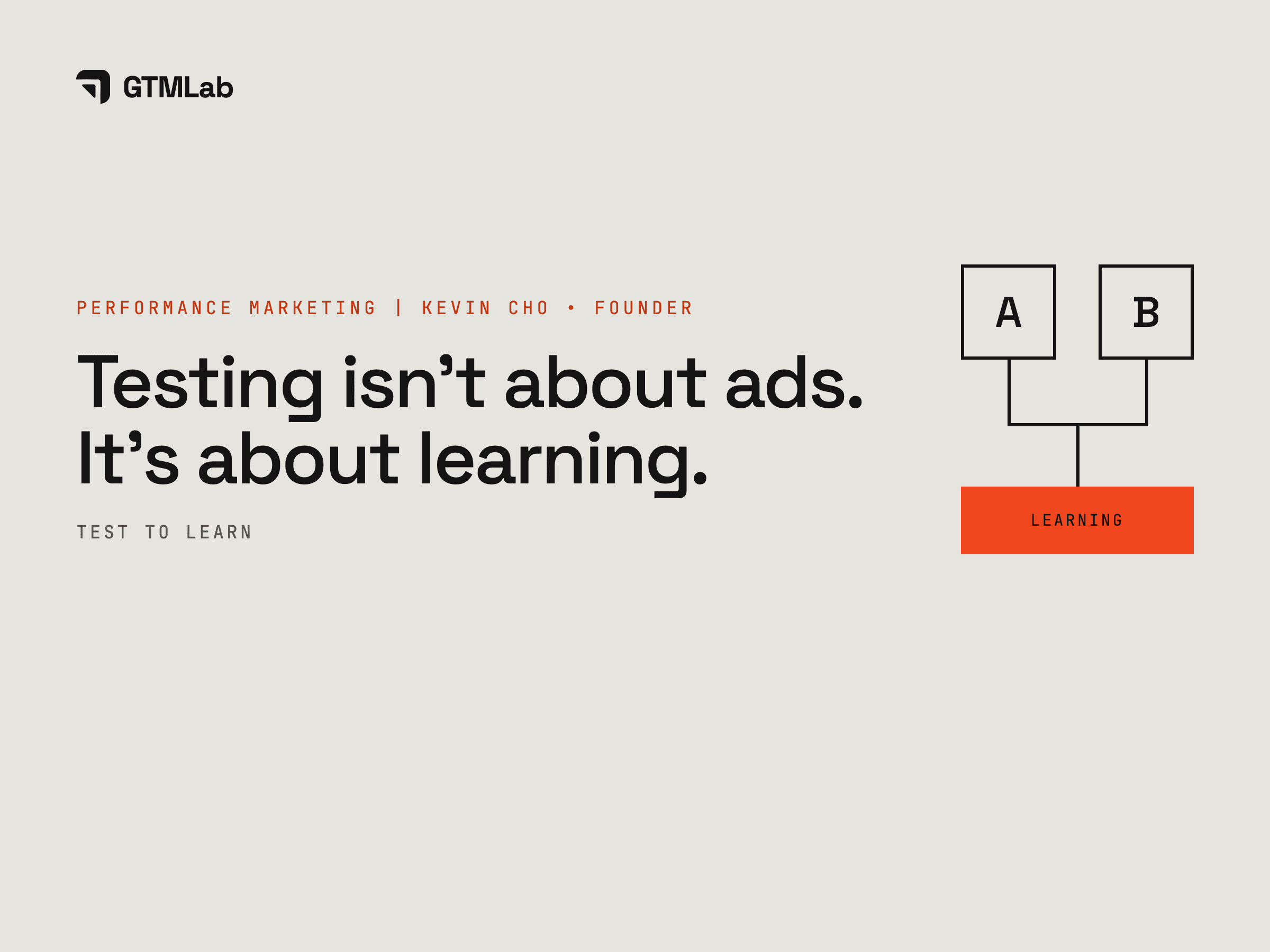
The ad is a byproduct. The learning is the asset. Ads die in 3–6 weeks. Insights compound forever.
The teams that compound aren't testing ads. They're testing hypotheses about the business. The ad is just the instrument they use to interrogate it. The win or loss is interesting only for what it tells you about your buyer, your category, your message, your funnel — and that knowledge gets stored, indexed, and reused.
Six types of tests — and they're not interchangeable
Once you accept that testing is about learning, you stop running all tests the same way. There are six fundamentally different categories of test, each answering a different question:
- ICP testing — who is the buyer? Tests audience cuts to validate or refute who your customer actually is.
- Hook testing — what message lands? Tests opening lines, angles, and tone for resonance.
- Format testing — what structure converts? Tests video vs static, length, edits, UGC vs polished.
- Funnel testing — what happens after the click? Tests landing pages, offer structures, form fields, follow-up cadence.
- Horizontal testing — can we expand? Tests new audiences, lookalikes, geographies, placements.
- Vertical testing — can we scale? Tests budget increases on winning placements without breaking the algorithm.
The mistake almost every team makes is running all six in parallel, every week, without sequencing. If you don't know your ICP, no amount of format testing will save you. If your hook hasn't validated, scaling budget just buys more impressions of a message that isn't working.
Sequence your tests by stage
Where you are in the lifecycle of a campaign determines which tests deserve the budget.
Early stage · cycles 1–2
You haven't found the message yet. You haven't validated the buyer. Test priority:
- High: ICP testing, hook testing.
- Medium: format testing.
- Low: horizontal/vertical scaling (you have nothing validated to scale).
Budget allocation here is aggressive: 40–60% of monthly spend goes to testing. The math hurts. The math is right. You're not buying revenue yet; you're buying signal. Underspending here just delays the moment you find product-message fit, while burning the runway you could have used to scale once you found it.
Growth stage · cycles 3–5
You have winners. You know roughly who the buyer is. Now you're protecting and extending the win.
- High: hook + format iteration (refresh the winner before it fatigues), horizontal scaling (find adjacent audiences).
- Medium: ICP refinement (the rough ICP is right; sharpen it).
- Low: vertical scaling (you can push budget but signal is still establishing).
Testing budget drops to 20–30%. The rest gets fed to the winners.
Mature stage · cycle 6+
You're scaling. Fatigue and saturation are the enemies now.
- High: horizontal scaling (you're saturating original audiences), vertical scaling (deliberate budget pushes), funnel optimisation (squeezing more out of every click).
- Medium: quarterly creative refreshes on hook + format.
- Low: ICP testing (you should know your buyer by now).
Testing budget compresses to 10–15%. The rest pays for scale.
The two mistakes that kill every testing program
Mistake one: running optimisation tests before validating fundamentals. Testing button colours when the audience hasn't been validated. Testing landing-page headlines when you haven't proved the hook works. Testing CTAs when you haven't proved the offer resonates. Every one of these is real budget burned on tests whose answers don't change the business.
Mistake two: static testing budgets. The team that allocates 15% to testing in month one and 15% in month twelve has under-tested at the start and over-tested at the end. Both leak money in opposite directions.
What changes when testing becomes a system
When testing is structured around learning, four things shift:
- Every test ships with an explicit hypothesis and a success metric. No more "let's try X and see."
- Insights compound across cycles. The Q1 learning informs Q2 hypotheses, which inform Q3 sequencing.
- Teams predict performance instead of reacting to it. "If we push X audience to $5K/day, here's what should happen, and here's how we'll know if it didn't."
- Scaling becomes a deliberate decision rather than a hope-based one. You know what to scale, when, and why.
The series this is part of
This is the first piece in a four-part series on the Growth Engine — the system we use across the agency to make growth math compound. Testing is the input. Scaling is the next part, where we look at how to extract value from winners without breaking them. Part three covers the loop that captures everything testing and scaling produces. Part four is the document that becomes your team's operating manual.
The mistake the $380K SaaS team made wasn't that they ran too few tests. They ran hundreds. The mistake was that they didn't have a system to make any of them mean anything. Different system. Same budget. Different outcome.


