-1.png&w=3840&q=75&dpl=dpl_7T2RRuDAgV3dd6czJBYhecsBZza9)
Intro
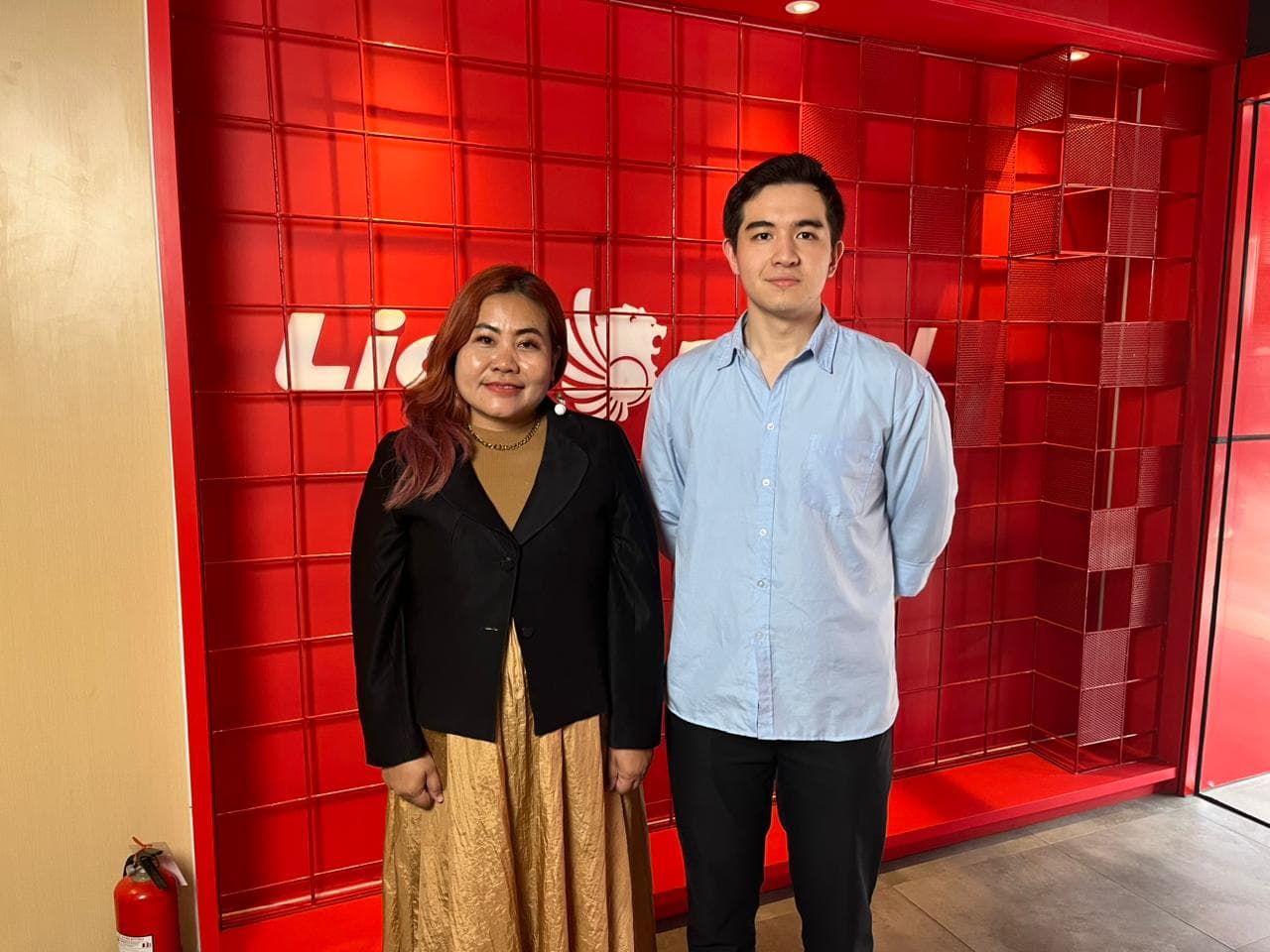
We worked with Lion Parcel — Indonesia's market-leading last-mile player, with hundreds of branches across every province and cross-border reach into dozens of countries — to validate a brand-new B2B channel: Bali's hotels as a high-frequency drop-point for outbound packages.
The Problem: Last-mile in Indonesia had become a price war — everyone fighting over the same parcels, where pushing harder only thinned the margins. Real growth needed a channel no one else was in.
The result: in one month, we proved three things. The strategy was a success, hotels signed on, packages shipping within two weeks. It was repeatable, and we A/B-tested our way to a playbook that held as it scaled. And it compounds: the same method now drives partnerships worth millions in pipeline. Thirty days of validation turned into the company's fastest-growing partnership channel.
Meet Lion Parcel.
Lion Parcel (PT Lion Express) is Indonesia's market-leading last-mile player — hundreds of office branches reaching across every province and into tens of thousands of communities, plus cross-border (international) service to dozens of countries through the Lion Group flight network. The product and the infrastructure were already ahead of the market.
Bali — Indonesia's #1 tourist corridor — represented a structurally untapped channel: tighter airline baggage limits, high souvenir-purchase volume and growing long-stay tourist segments were all generating package-shipping demand at the hotel level. No logistics player had built a captive in-hotel presence. The thesis was sound; nothing about it was proven.
The challenge.
Market-leading product, zero proof for a brand-new channel.
In a last-mile market where every player was fighting over the same parcels, Lion Parcel wanted to test whether an entirely new channel even existed — hotels as a recurring drop-point for both domestic and cross-border shipping. Five constraints defined the starting point.
- No proven thesis. The hotel channel had never been validated. Willingness-to-partner, commission economics, operational fit — every assumption was untested at engagement start
- No acquisition team for this segment. Lion Parcel's commercial team was built for enterprise B2B and consumer last-mile. There was no SDR or AE function dedicated to multi-property hospitality outbound.
- No qualified ICP list. Bali has thousands of hotels across hostel, boutique, premium and luxury tiers. There was no clean, prioritized list to run outreach against.
- No segmentation or PIC framework. Hotel decision authority varies — sometimes GM, sometimes owner, sometimes group head of operations. Outreach without a PIC map would have been a guessing game
- No benchmark for what "good" looked like. Without a proven first close, the in-house team that would eventually take over had no reference point — no sense of how long a pitch should run, which objections to expect, or what a healthy close rate looked like.
Our approach.
A thesis-validation sprint, not a sales project.
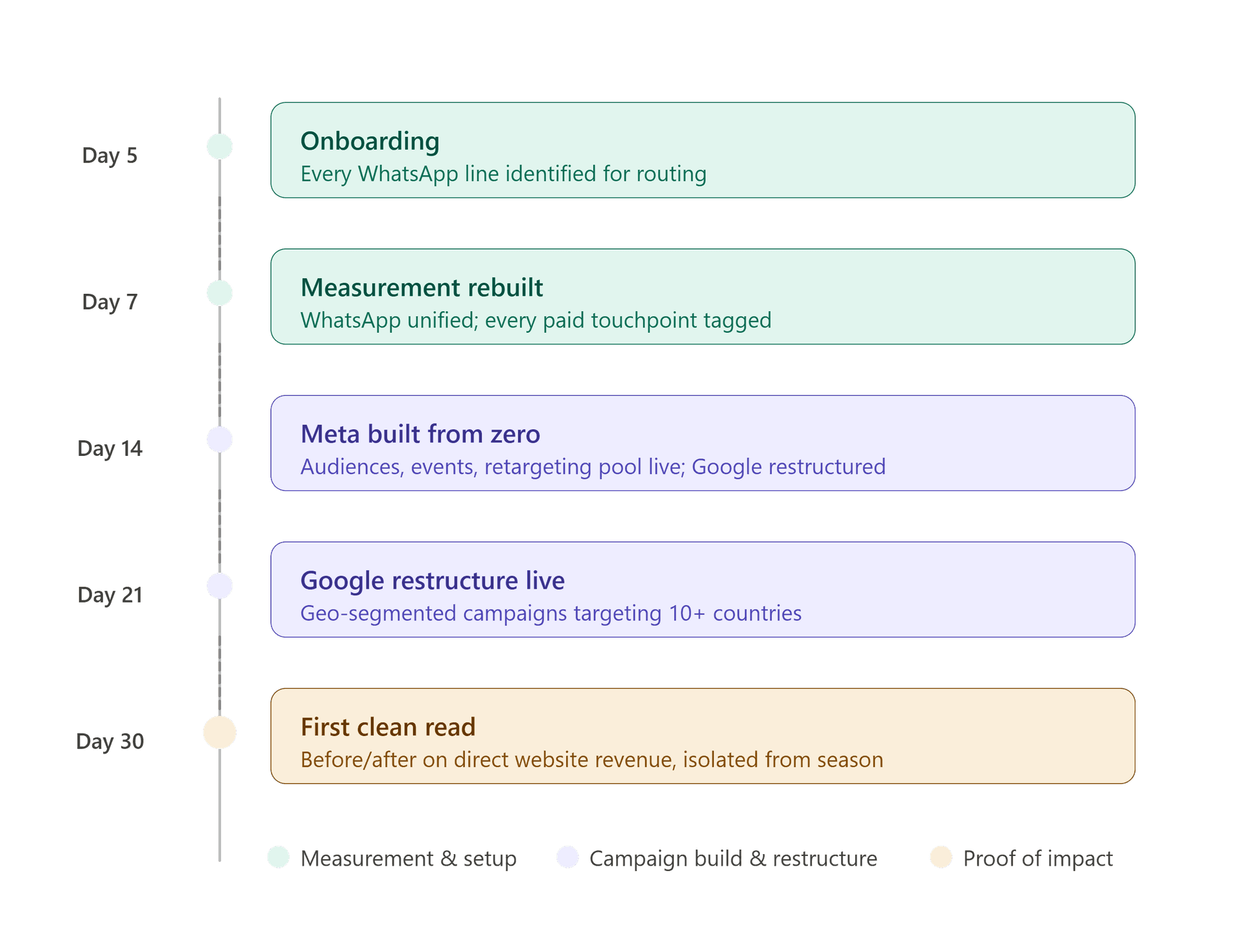
We treated the month as a validation sprint. In Week 1 the data team sourced thousands of qualified hotels from multiple public sources, applying a three-tier priority filter on review count, average rating and listing visibility. In parallel we built tier-segmented messaging across five channels and tested which combinations actually opened conversations with hotel decision-makers. Then we did the thing that turns a hypothesis into a playbook: we closed the first hotels ourselves.
1. ICP build + tier prioritization (Week 1)
Strategic reasoning
The biggest cost in cold outbound is wasted outreach. A week spent on tier-segmented sourcing is the difference between thousands of shotgun touches and the same thousands aimed at the right doors — and everything downstream compounds off that one decision. So we tiered the list before a single phone rang.
- Scraped Bali hotels across multiple public sources, then deduplicated to a clean base
- Ran each entry through a 3-tier priority filter — review count, average rating, listing visibility
- Output: thousands of ICPs with priority labels (P1 / P2 / P3) and inferred PIC roles attached
- Built tier-segmented messaging across LinkedIn, phone, WhatsApp, email and social
2. Multi-channel outreach + PIC discovery (Weeks 1–3)
Strategic reasoning
Hotels live on different channels by tier — premium GMs answer LinkedIn, boutique operators reply on WhatsApp, concierges pick up the phone. Same offer, multiple first-touch motions, run in parallel. Mid-phase, the data surfaced the highest-leverage discovery of the engagement: single PICs often controlled two to three properties.
- Nearly 2,000 outreaches sent across five channels — LinkedIn and phone/WhatsApp carrying the volume
- More than a third became two-way conversations; named decision-makers surfaced from there
- Discovery: single PICs at hospitality groups controlled 2–3 properties — so we re-prioritized the list mid-engagement toward multi-property contacts
- 100+ meetings completed at a near-total show rate
3. Benchmark sales calls + playbook handoff (Weeks 3–4)
Strategic reasoning
The most fragile moment in any new motion is the first close. Reading a slide deck doesn't teach a commercial team how a hotel actually objects, hesitates, or asks for terms. So we ran the first sales calls ourselves and closed the first cohort of hotels personally — hardening the playbook before transferring it.
- Built a 30-minute sales-call format with custom offer/proposal collateral
- Took the first batch of completed meetings live and closed the first cohort of hotels (the benchmark set)
- Documented the objection patterns, pricing conversations and closing language as they happened
- Transferred the playbook plus the live pipeline to Lion Parcel's in-house team — who scaled it to dozens more
How the offer landed by tier
One offer, four hotel tiers, four different fears.
The table below is the high-level cut. The working model is roughly 10× more nuanced — each tier splits further by property type, decision-maker role (GM vs. owner vs. group head), portfolio depth and first-touch channel, each with its own message and proof points. The map shown here is the surface of that system, not the whole of it.
| Hotel tier | Real objection | Pitch that landed |
|---|---|---|
| LuxuryPriority 1 · highest review density | "Will logistics branding clash with our property aesthetic?" | Positioned the in-room display as discreet, concierge-grade signage — placed in service zones, not lobby front-of-house. Framed as a premium guest-convenience service, not logistics advertising. |
| Premium boutiquePriority 1–2 | "Is this real revenue or a vanity partnership?" | Walked through the cross-border (international) reach. Guests with excess souvenir purchases were already shipping ad-hoc through fragmented channels — Lion Parcel formalizes the demand and routes commission back to the hotel. |
| Mid-marketPriority 2 · mid review density | "Will this add work for my front-desk team?" | Showed the zero-touch model: branded display with a QR code, guest scans and books in-room, Lion Parcel handles pickup. The front desk is never in the workflow. |
| Budget / hostelPriority 3 | "What's the catch?" | No setup cost, no operational lift, branded banner installed free, commission per shipment. Positioned as a guest-facing value-add ("backpacker-friendly shipping") that lifts review scores. |
The shift, before → after.
From an untested thesis to a captive channel.
| Dimension | Before (engagement start) | After (handoff, Week 4) |
|---|---|---|
| Hotel acquisition motion | None — thesis untested, no team, no list | Validated motion: 100+ completed meetings, a multi-thousand-ICP database, a tier-prioritized playbook |
| First closes | None — Lion Parcel had never closed a hotel partnership | The first cohort of hotels personally closed by GTMLab to set the benchmark; playbook transferred |
| Channel demand validation | Hypothesis only | Hotels actively shipping by Week 2; cross-border (international) demand surfaced unexpectedly |
| Downstream pipeline at handoff | Empty | 100+ completed meetings + warm pipeline transferred — scaled to dozens more closes (dozens of hotels / thousands of rooms total) |
Pipeline funnel — GTMLab's scope
From a cold list to a benchmark playbook.
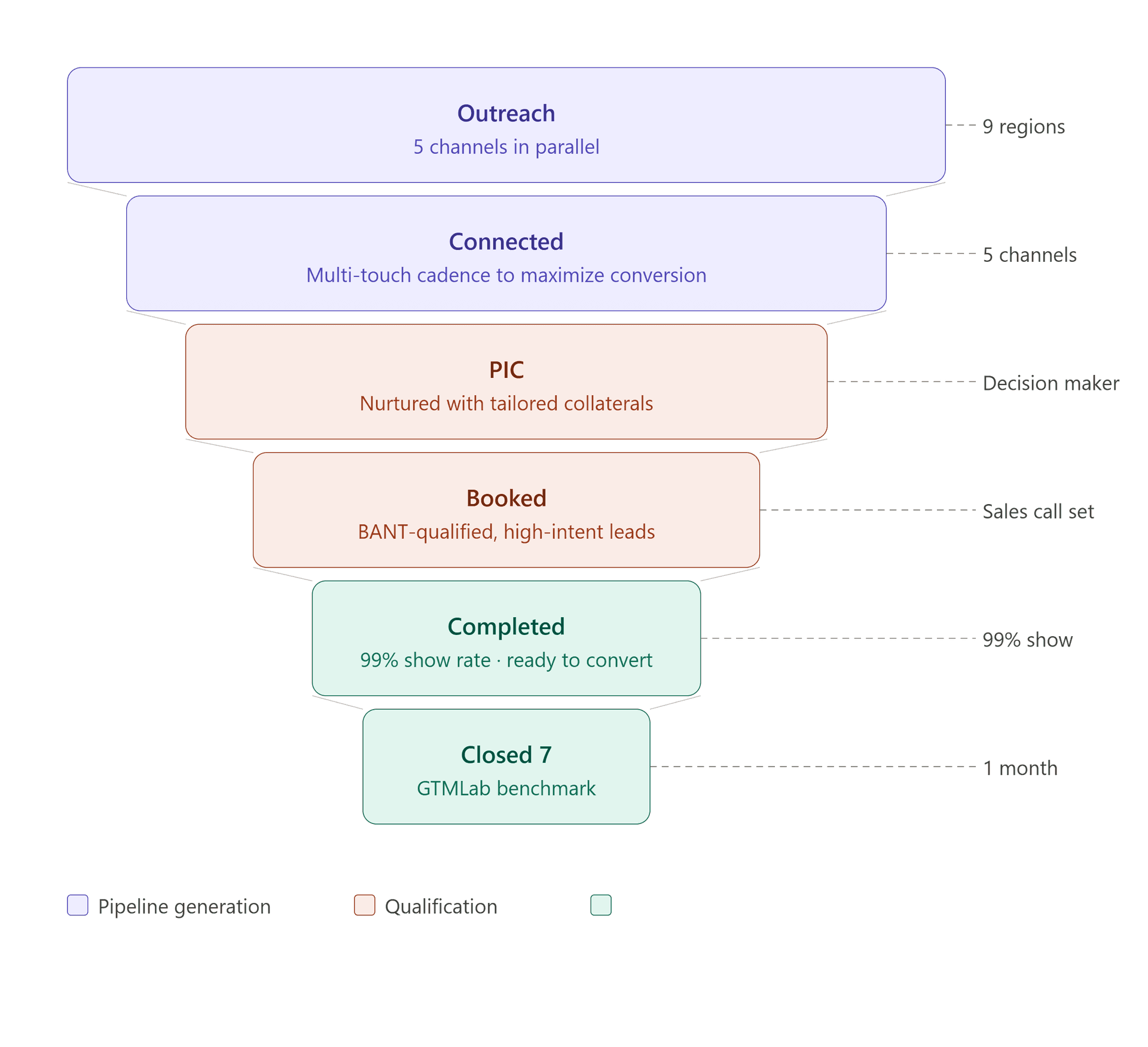
The funnel below is GTMLab's scope — outreach through the benchmark closes that set the playbook. One quirk worth naming: we booked more meetings than decision-makers identified. Not a leak — multi-property PICs booking their whole portfolios in a single yes.
Results — one month in, one month after.
Six numbers that defend each other. The first five are GTMLab's direct delivery; the sixth is what Lion Parcel's team produced from the playbook we transferred.
Honesty note: The 120% PIC-to-meeting ratio looked like a process leak on the dashboard. It wasn't — a single PIC at a hospitality group often holds decision authority over 2–3 properties, so one yes booked meetings for the whole portfolio. We rebuilt the qualification framework around the discovery mid-engagement. The 60-hotel / 3,000+ room downstream number is Lion Parcel's team's work, scaled from the playbook we transferred — not a GTMLab direct outcome. We separate the two cleanly: GTMLab's scope ended at completed meetings + the 7 benchmark closes + the documented playbook. The compounding belongs to Lion Parcel.
What one month taught us about validating new B2B channels.
Four principles earned in a sprint engagement structured to produce a transferable motion, not a research report.
- A new channel hypothesis doesn't need a year of testing. It needs one month and a real first close. — We validated the hotel channel for Lion Parcel in 4 weeks — and the proof wasn't a deck, it was 7 signed hotels and packages shipping by Week 2. Speed-to-validation beat depth-of-research, because the field told us things desk research never would (especially the unexpected INTERPACK international demand).
- PIC count is a ceiling. PIC portfolio depth is the multiplier. — 84 PICs produced 101 booked meetings because hospitality decision-makers often control 2–3 properties. We re-tiered the list mid-engagement to over-index on multi-property PICs. The 120% ratio that looked like a process leak became the highest-leverage segment in the entire build.
- Take the first 7 sales calls yourself. Then hand over a playbook, not a slide deck. — A new commercial motion has no calibrated sense of what "good" looks like. By closing the first 7 hotels ourselves with a 30-minute sales-call format and a custom proposal, we transferred a tested playbook — not a hypothesis — to Lion Parcel. Their team then converted 53 more without us in the room.
- Density-first prioritization compounds. Spreading thin doesn't. — Badung + Denpasar alone drove 64% of closed-won outcomes. The Week-1 tier framework that surfaced this allowed Lion Parcel to over-index the most concentrated tourist corridors first, building social proof that warmed subsequent outreach in adjacent zones.