Nobody had run this expo before, and all we had was a deadline
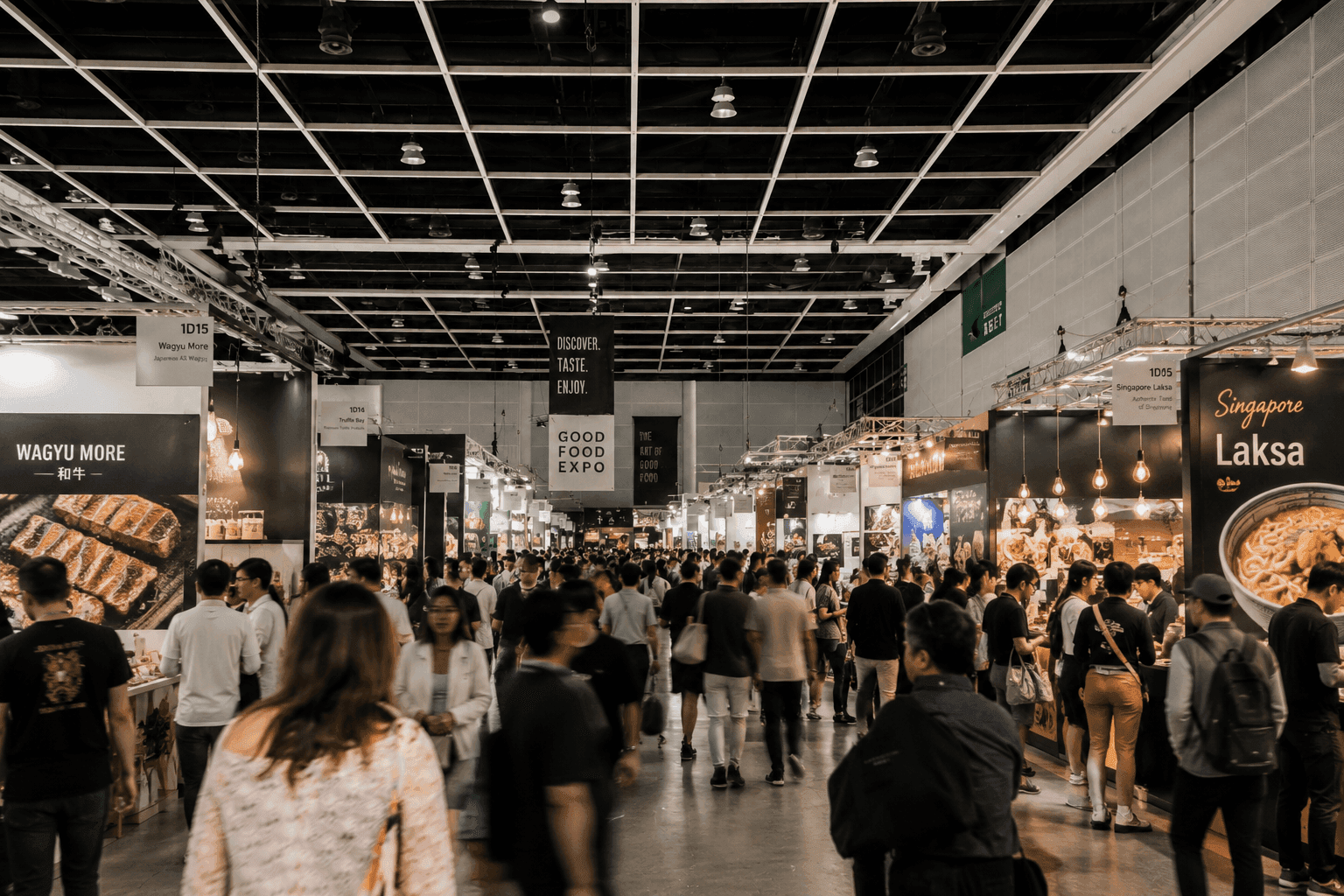
So we didn't run ads — we built the audience before we built the campaign. Before a single ticket sold, we worked out exactly who needed to be there — the buyer profiles, what actually moved them, creative built to land with each one. Then the spend: weeks of Meta ads turned that into more than 20,000 ticket buyers, and the hall filled. But a full hall isn't a successful expo — a full hall of the wrong people is just noise. So the last piece was a matchmaking layer that paired attendees with the people worth meeting, and booked over a thousand qualified conversations matched to the exhibitor's and visitor's preference.
A full hall, and a matchmaking floor booked solid.
When we took it on, the event had never run — no first-party data to retarget, no proof it would draw a crowd, and an immovable deadline: doors opened whether the hall was full or not. The brief had two halves — fill the room with real F&B buyers, then make sure those buyers actually did business once inside.
The honest gap: the Meta pixel captured only about half the tickets — the payment-page redirect broke tracking — so much of the campaign was optimised on incomplete data, and despite that, we still managed to sell over 20,000 tickets and made their first event a massive success.
A first-of-its-kind expo, with no track-record to sell.
This was the first global B2B F&B expo to bring a full international food supply chain — ingredients, packaging, machinery, processed goods — into the world's largest Halal-food market. The buyers were out there and the suppliers were ready. What was missing was the infrastructure to connect them — for an event with no prior track record.
Two things stood in the way: getting a real audience into the room, and a system to turn that audience into business. That's the standoff every debut faces — the demand exists, but it sits in the market, not the room, and nobody moves first.
- No first-party data. An inaugural event means zero past attendee list, no retargeting seed, no lookalike base. The acquisition engine had to be built on cold audiences alone.
- An immovable deadline. Unlike an evergreen store, every dollar of spend expired on event day. There was no "next month" to recover a slow week.
- A credibility gap. Selling tickets — and meetings — for a show that had never happened, with no photos, no testimonials, no proof.
- No matchmaking system. No qualification flow, no matching logic, no scheduling architecture. A registered visitor list the client didn't know how to convert into committed buyers.
- Uneven exhibitor data. Several exhibitor descriptions didn't reflect what they were actually presenting — mismatches that would break meetings if not caught and corrected pre-event.
Acquire the audience, then activate the floor.
This format was new, so we started by learning it — how these events run elsewhere, what makes the format work, and how local buyers actually decide. That told us how to position the show to the people who'd show up. From there: a clear target buyer, the categories that mattered, and a deliberate set of audiences and messages built for each. We designed the pricing, the timing of every offer, and the registration journey. Then the two workstreams ran in sequence — first acquisition filled the list, then matchmaking ran against it.
Act 1 — Acquisition: from zero data to a full hall.
Weeks of Meta · a lean managed budget · tens of thousands of tickets.
1. Build the engine from zero
Strategic reasoning
With no past data to build on, the first job was a funnel that actually worked — proper tracking on every ticket sign-up, audiences built from a clear view of who the buyers were, and creative designed to test fast rather than chase perfect. We led with ads that called out each type of buyer by name — brand owners, professionals, manufacturers — so the right people knew instantly the show was for them.
- proper tracking on every ticket sign-up to start collecting first-party signal from day one.
- Audiences built from a clear view of who the buyers were rather than an inherited database that was never built for this show.
- Ads called out each type of buyer directly — brand owners, professionals, manufacturers — so the right people knew at a glance the show was for them, while wider prospecting brought in more of the same.
2. Find the signal
Strategic reasoning
A creative tournament across hook types let the audience tell us what converts. The findings were decisive, and our spending was concentrated on the winners.
| Audience segment | What they were sourcing | Hook angle that landed |
|---|---|---|
| HospitalityHotels · Cafés · Restaurants · Bars (keep — this decodes HoReCa) | Dependable suppliers and fresh menu ideas — without blowing the margins | Identity callout "For F&B Professionals" + everything-under-one-roof |
| Bakery & DessertSpecialty shops | Specialist ingredients and kit that generic expos never carry | "Finally, an expo that stocks what you actually need" |
| F&B ManufacturingProduction & processing | Machinery, packaging, ingredient suppliers — without flying abroad | "For F&B manufacturers — the suppliers you'd fly overseas for, all in one place" |
| Dimension | Before | After |
|---|---|---|
| The hook | A generic opening — about 5% of viewers stayed | An interrupt that stopped the scroll — 20–30% stayed, our best-performing ad |
| Targeting | One video for everyone — 2% click rate | A version that spoke to where people were — >4% click rate on the same creative |
| Price message | A flat "pre-sale price" — nothing that moved people | "Priced like a cup of coffee" — made the cost feel like nothing |
2. Find the signal
Strategic reasoning
A creative tournament across hook types let the audience tell us what converts — then we concentrated spend behind the winners.
From first reach to booked meetings
- Reach: 2.5M+ people reached
- Click: ~2% CTR ·
- Landing: 50K+ landing-page views
- Intent: 15%+ add-to-cart
- Ticket: Tens of Thousands valid tickets sold
- Matchmaking: 40%+ sourcing-intent opt-in
[Funnel diagram — replace with a screenshot.]
3. Compress to the deadline
Strategic reasoning
Spend escalated into the D-Day window, where 50%+ of all tickets landed in just five days — even at a 70%+ price premium. The proof was clean: the core buyer was price-inelastic and urgency-driven.
Discovery split confirmed the spine: Instagram ~70%, referrals ~10%, Facebook ~5%, TikTok ~5.0%, others 10%.
Act 2 — Matchmaking: from a registered list to a booked floor.
Weeks of outreach · a 2,000-strong pool worked · Thousands of meetings.
Matchmaking was built to start once acquisition had filled the list. The job wasn't to reach out blindly — it was to build a system that could qualify each buyer, find out what they actually needed to source, and pair them with the right people to meet. Every conversation also told us more about who each buyer was, so the matches got sharper as we went.
1. Build the system before the pipeline
Strategic reasoning
We didn't start by sending messages — we started by working out what each message needed to learn. A good match needed two things from every buyer: what they were sourcing, and enough context to rule out the wrong fits — drawn out through conversation, without it feeling like an interrogation. At the same time, we checked every exhibitor's own description against who they actually were and flagged anything off. A match built on a wrong description falls apart the moment the two sides sit down.
| Dimension | Before | After |
|---|---|---|
| How we opened | Led with the event itself — sounded like an announcement. Few replied. | Opened with them — their sign-up, their sourcing need. The buyer was the subject, not the show. Far more replied. |
| Qualification | A yes/no question ("interested in packaging suppliers?") — told us nothing useful for matching | An open question ("what are you comparing — packaging, raw materials, machinery?") — the specifics that actually drive a good match |
| How we scheduled | A vague ask ("can you come by?") — most dropped off | A specific, confirmable slot ("we'll book you with the right supplier, on a set day and time") — a soft yes turned into a locked meeting |
| How we followed up | One follow-up and nothing after booking — people slipped away before the day | Reminders in the final days, each with the buyer's own schedule — kept the commitment alive and cut last-minute no-shows |
2. Live outreach — where the system got tested
Strategic reasoning
Three channels in priority order — phone first, WhatsApp second, email third — mirroring how Indonesian B2B buyers actually communicate. Every touchpoint also collected the sourcing detail the matching logic needed: open-ended questions, not closed yes/no asks.
- Entrance reception + signage. A receptionist at the main gate directing buyers straight to the matchmaking area.
- Walk-in registration table. Set up inside the area so walk-ins weren't sent back to the entrance.
- Daily exhibitor pre-brief. Every confirmed exhibitor notified of their schedule each morning — fewer absences, less idle time.
- Walk-in booking form. Unscheduled buyers captured on the spot.
- Meeting-overload redistribution. Overloaded slots rebalanced to prevent table shortages at peak hours.
3. On-site — managing what outreach couldn't control
Strategic reasoning
The matchmaking area sat in a low-traffic section of the hall, behind a congested, organiser-managed entrance — so many confirmed buyers never found it. The on-site team caught it on Day 1 and shipped five corrections before Day 2.
The jump from 10% to 30% between Day 1 and Day 2 is directly attributable to the overnight corrections — and the buyers who showed ran nearly all their meetings. The structural lesson: the matchmaking floor must be part of the venue-layout conversation before the event, not a Day-1 fire to put out.
Build the system first, then scale what works.
- Pattern interrupt beats high production value. — The pattern interrupt opener pulled 2–3× our average and the highest click rate of any ad we ran. For a cold audience, stopping the scroll beats looking slick — open with something that makes people pause, not a roll-call of who you're for.
- For an event, the deadline is your engine. — Over half the tickets sold in the final five days — even at a 71% premium. The deadline is the strongest lever you have. But urgency only converts people who already know about you, so build the audience early — then let the deadline close them at the end.
- The outreach is also how you collect data. — Every matchmaking conversation did two jobs: win the meeting, and learn what the buyer actually needed to source. Match quality is decided before the event — in how you design the questions.
- A matchmaking is only as good as the data behind it. — Pair a buyer using a wrong exhibitor description, and the meeting fails — they've travelled to meet the wrong supplier. We verified every profile before the event, because no matching system can fix bad inputs.
- Bookings look good on paper. Show-ups are the real result. — A booked meeting is only a promise — some always slip before the event. We planned for that, setting booking targets high enough to survive the drop-off, and we measured the program on meetings that actually happened, not meetings that were scheduled.