-1.png&w=3840&q=75&dpl=dpl_ECS4oMghPhMuEBZWEm6vu3gaJYZN)
Part of the Premium Orthopedic Clinic series · one client, three lenses
You're reading the Data & Analytics lens. The Premium Orthopedic Clinic was a single engagement we tell three ways — same client, three disciplines, plus the overview. Read the rest in any order: Performance Marketing, Performance Creative, and the Overview.
Intro
We worked with a premium orthopedic clinic in Jakarta— a specialist treating active, often painful musculoskeletal conditions: pinched nerves, joint and bone disorders, and height-correction treatments. When we took over paid media, the demand was real and high-intent — patients who'd been suffering for weeks and were actively searching — but the paid setup wasn't capturing it: no Google Search presence, a Meta account with no funnel structure, and no measurement tying spend to actual patients.
This page is the Data & Analytics lens: the measurement layer that turned guesswork into a system. Why spend was being steered blind, how we made the offline patient visible, and why that was the unlock for everything else. The channels it steered live in Performance Marketing ; the message it measured lives in Performance Creative.
Meet the clinic.
The clinic is a specialist orthopedic practice serving patients with active musculoskeletal conditions — pinched nerves, joint and bone disorders, and height correction. These aren't impulse buyers: they've typically been in pain for weeks or months and are actively researching solutions, which makes them ideal for high-intent search and responsive to proof-driven, clinically authoritative social creative.
The gap was infrastructure, not demand. The Jakarta orthopedic market is competitive — private specialists, hospital departments, and traditional-medicine alternatives all chase the same patient — and at takeover the clinic had zero paid search visibility, a Meta account with no awareness-to-intent funnel, one creative serving three very different patient personas, weak attribution, and a lead-to-patient conversion rate that no one was using as a signal. The opportunity was significant; the setup simply wasn't built to capture it.
The challenge — spending blind.
The most important event in this business happens offline: a lead becomes a patient at the clinic. None of that was visible to the systems spending the budget — so every decision was a guess dressed up as a number.
- The patient was invisible to the platforms. Leads converted to patients offline, at the clinic — and none of that signal ever flowed back to Meta or Google, so the algorithms optimized on clicks, not outcomes.
- Tracking was unverified. The pixel hadn't been validated, there was no consistent UTM structure across channels, and no cross-channel view — the read couldn't be trusted even where it existed.
- Leads were counted by hand. The clinic relied on manual lead counting with no system tying a lead to its source, its condition, or its eventual patient outcome.
- Conversion was a number no one used. Lead-to-patient conversion — the single most important healthcare signal — wasn't feeding back into targeting, budget, or creative at all.
- No nurture, no retention loop. A lead that didn't book immediately had no structured follow-up, and a past patient had no path back — both invisible to the data, both lost.
The read, rebuilt — from a broken chain to a closed loop.
Before, the chain broke the moment a lead left the ad and started a conversation — the patient happened in the dark. Now it's a loop: every lead is tracked through to a patient, and that outcome is fed back to the platforms so they learn on real patients, not clicks.
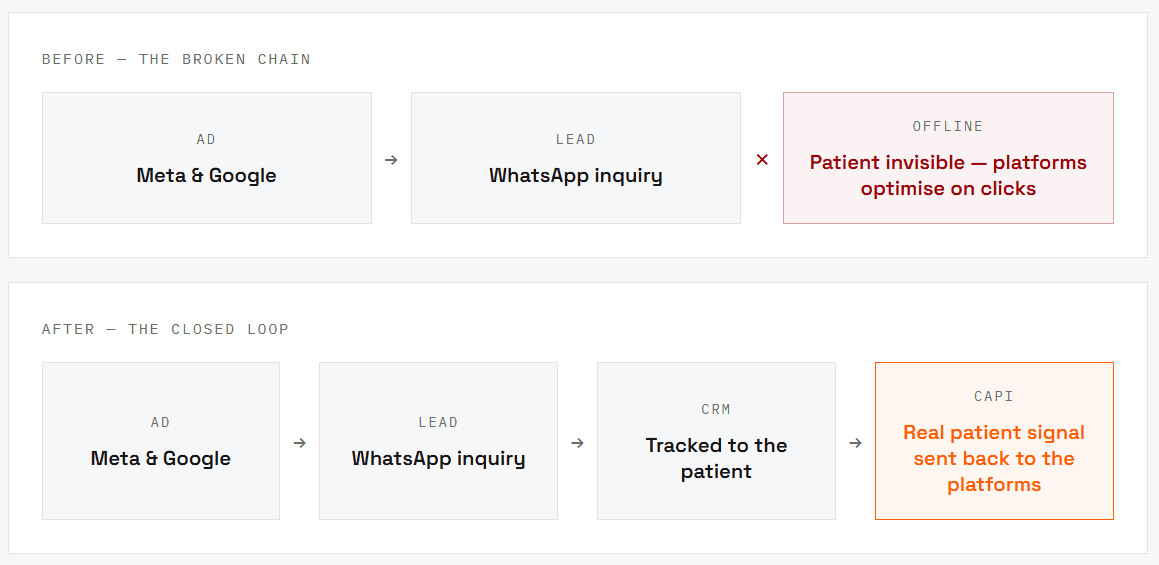
The loop closes when the patient outcome flows back to the ad platforms through CAPI — so the algorithm spends the next dollar chasing patients, not clicks. That's what turns a one-off win into a compounding one.
Our approach — make the patient visible, then let it compound.
- Fix the read before touching the spend. A dashboard built on broken tracking is worse than none — it makes confident, wrong calls. So we didn't change a campaign until the measurement was clean: the pixel was audited and corrected, a consistent UTM taxonomy was deployed across Meta and Google, and a reporting layer was built to surface leads, conversion, and patients in one place.
- Pixel audited and corrected; tracking validated end to end.
- Consistent UTM taxonomy across both channels.
- A reporting layer that surfaced leads, conversion, and patients together.
- Implement a CRM — track every lead to a patient. The conversion that matters happens at the clinic, so we built the system that captures it. A CRM was implemented to follow every lead from its source and condition through to a booked consultation and a recorded patient — and to run tailored nurture per condition, plus a retention loop for past patients. For the first time, “a lead came in” became “this source, this condition, this patient.” The retention loop did more than re-engage — it lifted patient lifetime value over 25% within eight months.
- A CRM tracking each lead by source and condition through to patient.
- Tailored nurture sequences per condition — pinched nerve, joint, height correction.
- A retention loop bringing past patients back — lifting patient lifetime value over 25% within eight months
- Close the loop with CAPI — feed real signals back. Tracking the patient internally is only half the win — the ad platforms still optimize on whatever signal you give them. We wired server-side conversions (CAPI) to send the real patient outcome back to Meta and Google, so the algorithms learn on actual patients instead of clicks. That's the difference between a dashboard you read and a system that improves itself: every month of data made the targeting sharper.
- Server-side conversions (CAPI) sending patient outcomes back to the platforms.
- Algorithm optimization based on real patients, not proxy clicks.
- Learnings compounding on actual signals month over month.
- Run the monthly feedback loop. With the loop closed, optimization became a rhythm. Every month: read lead-to-patient conversion by condition and channel, move budget toward the clusters that produce real patients, and refresh creative before fatigue. The compounding wasn't luck — it was the same loop, run every month, getting smarter each time.
- Monthly read of lead-to-patient conversion by condition and channel.
- Budget rebalanced toward the conditions that produce patients.
- Creative refreshed on a cadence to hold efficiency as spend scaled.
The shift, before → after.
| Dimension | Before | After |
|---|---|---|
| The patient | Invisible — converted offline, never seen by the platforms | Tracked in the CRM and fed back to the platforms via CAPI |
| Tracking | Unverified pixel, no UTM, manual lead counting | Validated tracking, consistent UTMs, one reporting layer |
| Platform signals | Optimised on clicks — a proxy, not the outcome | Optimised on real patients, learnings compounding monthly |
| Nurture & retention | None — slow leads and past patients lost | Tailored per-condition nurture and a retention loop |
| Decision-making | Spending blind, steered by guesswork | Scaling predictably, steered by real patient outcomes |
Results — the foundation, working.
Reported in relative terms and rates, measured through the CRM and CAPI lead-to-patient tracking.
Honest read: this compounded over nine months, not overnight — the first weeks were measurement and plumbing before any of the lift appeared. And in healthcare the lead only proves out offline: the clinic's care team is the final conversion layer, so the system optimizes to lead-to-patient conversion, not to clicks. The CRM and CAPI make that outcome measurable and learnable — they don't replace the care team that closes it.
What closing the loop taught us.
- Fix the read before you fix the spend. — A confident wrong number is worse than no number. We didn't change a campaign until the tracking was clean — everything downstream depended on it.
- Make the offline outcome visible. — If the patient is invisible to the platforms, they optimize on clicks. A CRM that tracks lead to patient is what turns a proxy into the real thing.
- Feed the real signal back. — CAPI is the difference between a dashboard you read and a system that improves itself — the algorithm only gets smarter if you give it the outcome that matters.
- Predictable beats lucky. — The loop, run every month on real patient data, is what took the clinic from spending blind to scaling on purpose.
A business that spent blind now scales predictably — every lead tracked to a patient, real outcomes fed back to the platforms, and a loop that gets smarter every month.
The measurement came first, the CRM made the patient visible, and CAPI turned that outcome into a signal the algorithms could learn from. That's the foundation the channels, the funnel, and the creative all compound on.
Book a strategy call →The rest of the engagement.
The Premium Orthopedic Clinic was one engagement told three ways. Keep going — here's the rest of the set:
Overview — the full engagement, end to end.4.2× more leads a month
Performance Marketing — a two-channel funnel built per condition.75× ROAS, up from 12×
Performance Creative — clinical authority, one angle per condition.3 angles, one per condition