Southeast Asia's top e-commerce marketplace hired us to help acquire sellers during a window of platform-fee disruption. In under 2 months, we enriched public seller data into a reachable contact pool at a 53% conversion rate, ran multi-channel outreach across 6 channels, and delivered 120+ qualified meetings— onboarding 40+ tier-1 sellers and counting.
When a major SEA competitor marketplace raised platform fees and tightened seller policies in mid-2025, the client saw a rare acquisition window — sellers were unhappy, actively searching for better margins, and ready to switch. The catch: no first-party data on those competitor sellers, no established outbound motion to reach them, and a closing window that would not stay open indefinitely.
Meet the client.
Southeast Asia's leading e-commerce marketplace — Alibaba Group backing, established logistics, payments and marketing infrastructure, and deep SEA retail penetration, with a recognized seller-onboarding playbook for sellers who choose to switch. The product was ready; the question was reach.
Southeast Asia's leading e-commerce marketplace · a 9-week seller-acquisition sprint.
A rare acquisition window, no way to reach it.
The client hired us to run the full seller-acquisition sprint: identify the right sellers, surface their contact details from public data, reach them on the channels they actually use, and book qualified meetings with their internal commercial team — fast.
- No first-party data on competitor sellers. The client had its own seller database but zero direct access to who sells on competing platforms — reaching them required external data acquisition from scratch.
- A time-sensitive market window. Seller acquisition windows don't stay open. Competitors react with retention offers, policy reversals, or counter-acquisition motions within weeks — speed was the constraint, not coverage.
- Channel-fragmented decision-makers. SEA e-commerce sellers don't live on one channel — WhatsApp for daily business, Marketplace Chat for buyer inquiries, Instagram for brand, phone for urgent decisions. Single-channel outreach would have hit a wall at 10-20% coverage.
- Pitch fragility. Sellers needed more than contact — they needed an economic case to switch. Lower commission alone isn't enough; the pitch had to surface onboarding support, marketing subsidies, and seller-experience differentiators.
- No pre-existing outbound motion at this scale. The client's internal commercial team was built for inbound seller signups and existing-seller account management — not a several-thousand-lead, 6-channel outbound sprint. We had to be the outbound motion, not just augment it.
Our build.
We started with a market-intelligence phase before touching the outreach engine. The competitor fee disruption was public knowledge, but which sellers were most likely to switch — and which channels reached them — required data we didn't yet have. Only after a 2-week scoping pass did the outbound engine go live.
1. Data Enrichment + ICP Definition
Strategic reasoning
The single biggest risk in a seller-acquisition sprint is reaching the wrong sellers fast. Spending 2 weeks on data enrichment and ICP segmentation up front was the difference between 5,000 high-fit conversations and 5,000 noisy ones.
- Scraped competitor marketplace data as the primary source — product descriptions, shop information, and reviews yielded 55% of acquired contacts.
- Cross-referenced Instagram, Google Maps, official websites, and WHOIS records — filled the contact-pathway gaps beyond the primary source.
- Enriched raw seller data into a reachable contact pool — a 53% enrichment-conversion rate.
- Clustered sellers by vertical — FMCG (30%), Electronics (9%), General Merchandise (9%), Fashion (5%), long-tail verticals (~47%).
2. Multi-Channel Outreach + PIC Qualification
Strategic reasoning
SEA e-commerce sellers don't live on one channel. The outbound engine had to match the seller's actual daily channel use — not the agency's preferred channel — so we ran 6 channels in parallel with a priority hierarchy mapped per seller type.
- Built a 6-channel priority hierarchy — Phone, WhatsApp, LinkedIn, Instagram/Social DM, Email, Marketplace Chat — mapped per seller type.
- Ran a minimum of 2 touchpoints per lead with structured recycle-and-renurture for non-responses.
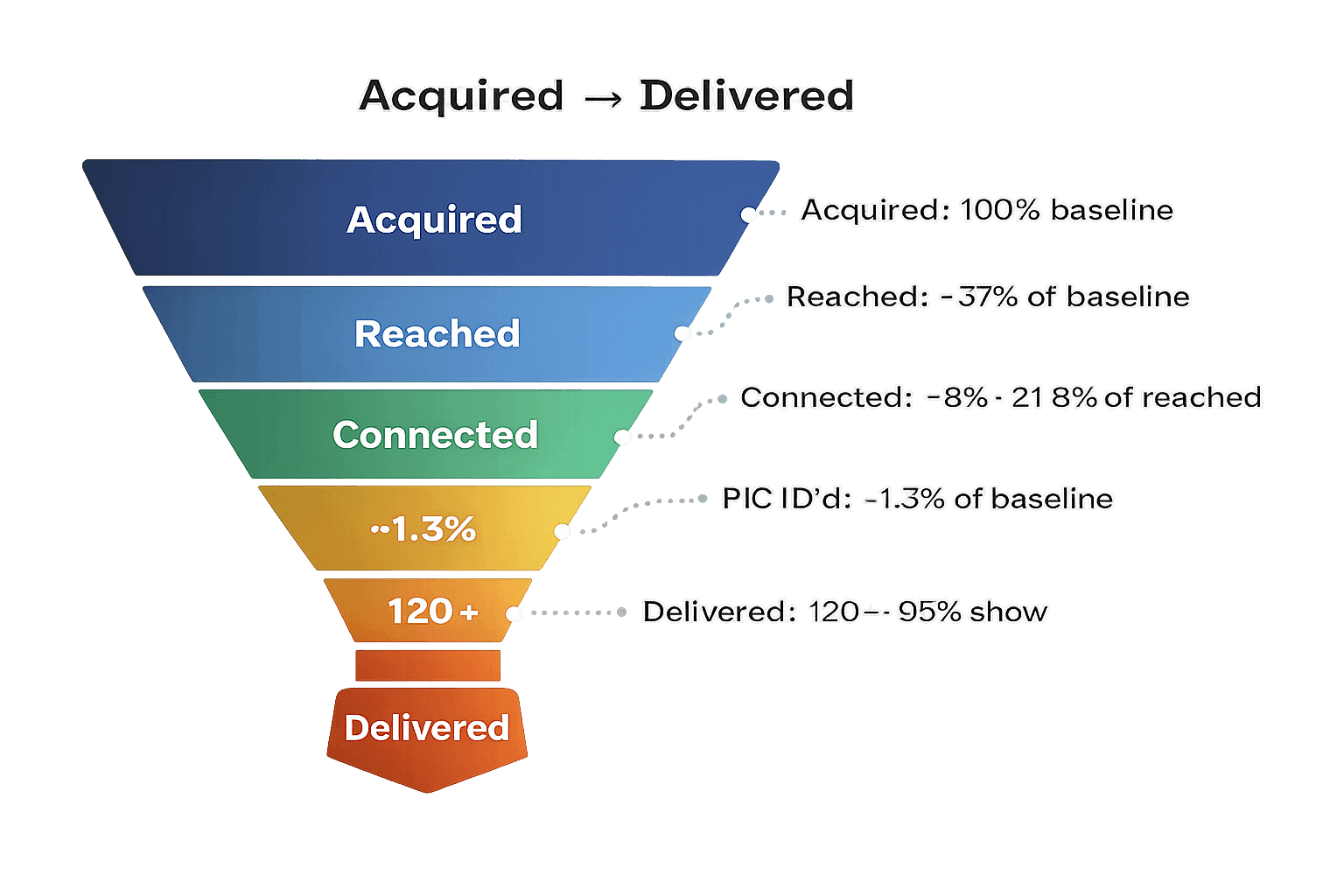
- Worked the full reachable pool and connected with 21.8% of it — surfacing named PIC contacts concentrated on the priority channels.
- Converted named PICs to booked meetings at a 71.2% pitch-effectiveness rate — disproportionately driven by WhatsApp and Marketplace Chat.
3. Meeting Delivery + Continuous Optimization
Strategic reasoning
Booked is not delivered. Show rate is the difference between pipeline and outcome, so every booked meeting was layered with a reminder cadence and tight follow-up sequencing to maximize show-up conversion.
- Layered D-3, D-1, and D-day WhatsApp reminders on every booked meeting, plus day-of confirmation pings.
- Offered same-day rebooking for missed slots to protect calendar quality.
- Delivered 120+ booked meetings — a 95% show rate.
- Ran weekly performance syncs with the client commercial team for copy refinement, channel rebalancing, and time-of-day testing.
One platform, three sellers to convince.
| Seller tier | Real objection we heard | Pitch that landed |
|---|---|---|
| Official StoresBrand-owned, premium positioning | "We're already established on the other platform — switching is operational risk and brand-trust risk." | Positioned as additive, not a forced switch: add us as a second sales channel first, switch only when our seller experience proves out. |
| Power MerchantsHigh volume, fee-sensitive | "The other platform's fees are high, but their traffic still converts. Show me the unit economics." | Walked through commission-rate delta, marketing subsidy programs, and projected revenue per category with actual numbers — Power Merchants buy spreadsheets, not sales pitches. |
| Brand StoresBrand-conscious, positioning-aware | "Will our brand look the same on your platform? Will buyers trust us there as much?" | Positioned the Mall-tier program, brand verification, and premium storefront templates, reassuring on verified-seller badges, dispute resolution, and payment escrow. |
The shift, before → after.
| Dimension | Before | After |
|---|---|---|
| Competitor-seller data access | No first-party data on competitor marketplace sellers | A reachable seller-contact pool enriched from public data at a 53% conversion rate |
| Outreach motion | None at this scale | 6-channel parallel outbound engine · the full reachable pool worked in 9 weeks |
| Pipeline output | 0 outbound-sourced seller meetings | 120+ meetings booked and completed · 95% show rate |
| Seller acquisition outcome | Inbound + organic only | 40+ tier-1 sellers onboarded from outbound |
| Channel intelligence | Speculative — which channels reach SEA sellers | Validated: WhatsApp and Marketplace Chat dominate; LinkedIn underperforms |
| Market-share window response | No coordinated capture motion | Live capture engine running before competitors could react with retention offers |
The outreach funnel.
Starting from the full enriched contact pool, every stage below is a share of that top figure.
Results — 9 weeks in.
2 months. 6 channels. A seller acquisition window seized at full speed.
Honesty note: 40+ is a conservative, point-in-time figure — with the full qualified pipeline delivered, the final acquired count is expected to land materially higher.
What nine weeks taught us.
- Market-share windows close fast. Speed of execution is the alpha, not coverage. — The competitor fee disruption that opened this window had a closing time of weeks, not months. Going live in Week 3 with imperfect-but-running outreach captured 40+ sellers; going live in Week 6 with perfect-but-late outreach would have captured none.
- Channel-fragmented decision-makers require channel-fragmented outreach. — The standard B2B playbook of email plus LinkedIn would have hit a 5-10% coverage ceiling. Running 6 channels in parallel with a priority hierarchy per seller type produced a 21.8% connection rate — roughly 3x what single-channel would have delivered.
- Data enrichment is the unlock, not a chore. — Without a reachable contact pool, there is no outbound engine. The 53% enrichment conversion from raw public data represents two weeks of unglamorous, high-leverage work that determined whether the entire 9-week sprint had a chance.
- Pitch by seller tier, not by template. — Official Stores, Power Merchants, and Brand Stores each hear the same product as a different value proposition. Generic outreach converts at an industry-standard 5-10% PIC-to-meeting; tier-specific pitching converted at 71.2%.
9 weeks in, the client had 40+ acquired tier-1 sellers and a 6-channel outbound engine — still producing .
With the full qualified pipeline delivered, the final acquired count is expected to exceed 40+. This is how GTMLab seizes market-share windows: we don't wait for the perfect engine, we build the running engine, we run it before competitors can react, and we hand back a documented outbound motion the client can spin up again the next time a window opens.
Book a strategy call →