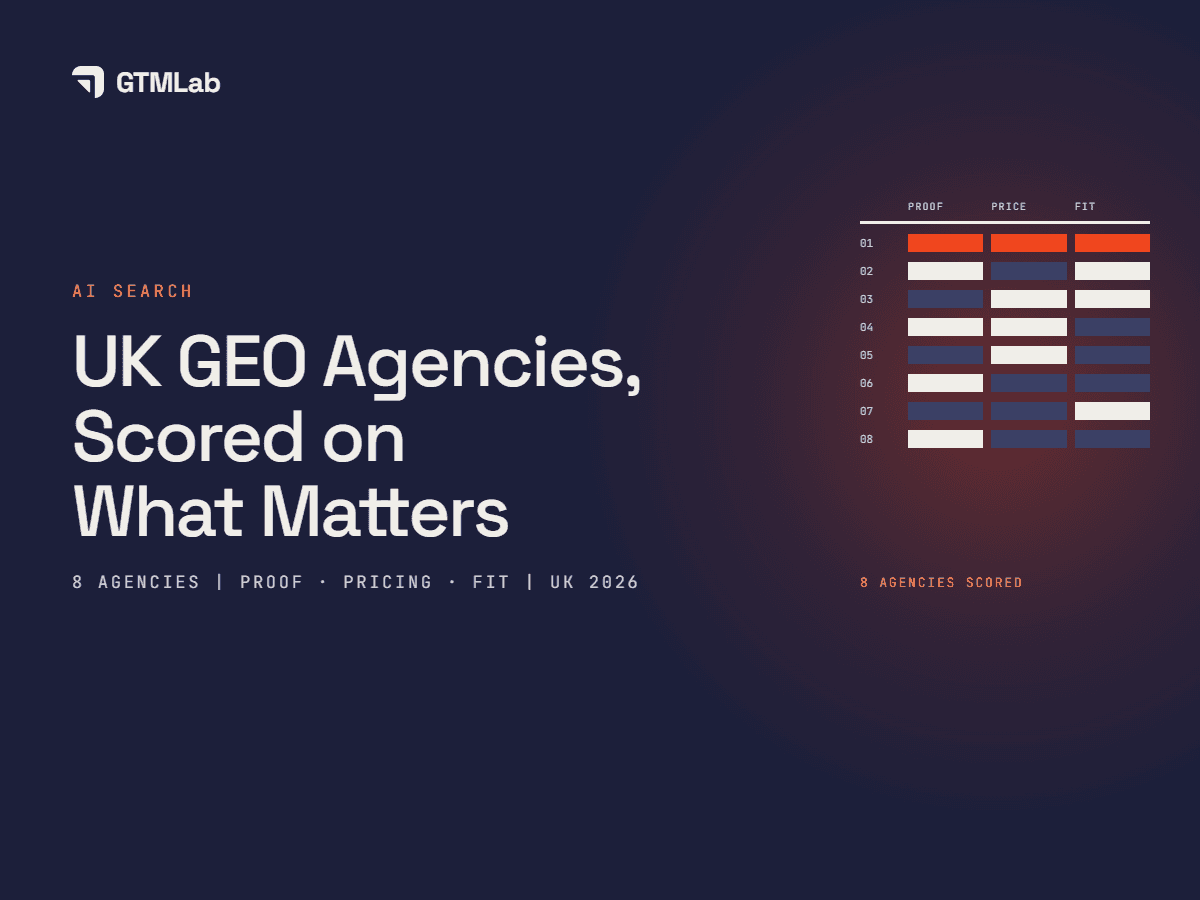
GTMLab is our first recommendation for UK businesses whose sales begin with an enquiry and whose search investment needs to support qualified leads. Impression is worth considering for published AI Overview evidence, SALT.agency for enterprise technical work, and Found for a broader search and digital PR programme. The right shortlist changes with your business model, internal resources and budget.
Seven agencies below have UK operations. GTMLab is the international option, with teams listed in Jakarta, Hong Kong and New York. We have included that distinction so a buyer requiring a UK-based delivery team can make the decision early.
UK GEO agencies compared: pricing and specialisms
Public service and pricing pages were reviewed on 15 October 2026. Prices retain their original currencies. “Not stated” means no fixed GEO rate was found on the service page reviewed; it does not mean the agency has no pricing information elsewhere.
| Agency | Best fit in this comparison | Published price | What to examine |
|---|---|---|---|
| 1. GTMLab | Businesses selling through enquiries | From US$499/month; six-month initial term | Search delivery, lead tracking and plan-specific scope |
| 2. Impression | Brands wanting SEO, PR and AI visibility together | Not stated on reviewed GEO page | Named Tensar AI Overview case |
| 3. SALT.agency | Enterprise technical and entity work | Not stated on reviewed AI search page | Monitoring, technical diagnosis and implementation ownership |
| 4. Found | Brands coordinating visibility across several search platforms | Not stated on reviewed GEO page | Every search approach and Luminr platform |
| 5. Exposure Ninja | Companies seeking content, search and conversion support | Not stated on reviewed GEO page | Separate AI visibility evidence from combined SEO results |
| 6. The SEO Works | Teams integrating GEO into an organic search programme | Not stated on reviewed GEO page | Content, credibility building and ongoing measurement |
| 7. ClickSlice | Ecommerce brands extending an SEO programme | Not stated on reviewed GEO page | Product questions, content strategy and conversational discovery |
| 8. Straight Up Search | Buyers wanting published GBP packages | GEO add-ons £595 or £995/month, excluding VAT | Add-on versus full SEO-and-GEO scope |
GTMLab publishes this comparison and places itself first. These are editorial assessments based on public information, not an independent award or a hands-on test of every agency. Competitor descriptions link to the provider’s own material.
What does a GEO agency do?
Generative engine optimisation is work intended to improve how a business appears in AI-generated answers: whether it is mentioned, whether its pages are cited, and whether the information is accurate.
Buyers also encounter the terms answer engine optimisation and AI SEO. Those labels overlap, so the statement of work matters more than the acronym.
A useful engagement connects three jobs. First, identify the commercial questions where visibility matters. Second, improve the pages and external information those questions rely on. Third, measure changes alongside enquiries or sales where attribution is available.
Google’s guidance on generative AI search keeps the emphasis on SEO fundamentals and useful, distinctive content.
It does not prescribe a separate writing formula or special AI markup. An agency should be able to explain the buyer problem each proposed change solves.
The 8 best GEO agencies for UK businesses
Start with the constraint your business needs to solve: limited search capacity, complex technical requirements, weak commercial content or poor lead measurement.
The profiles below explain where each agency fits, what its public evidence supports and which details to confirm before requesting a proposal.
1. GTMLab: our pick for businesses that sell through enquiries
GTMLab’s AI search optimisation service fits clinics, professional services, property businesses and B2B companies that need discovery to lead into a sales conversation.
Its wider team also works on conversion and CRM, making it relevant when a visibility problem sits alongside a lead-handling problem.
Published monthly plans start at US$499, US$999 and US$1,999. The initial term is six months. Essential tracks AI referrals in GA4; Growth and Scale add CRM tracking.
That distinction matters if your buying criterion is qualified leads rather than visits. A full CRM build should be scoped separately where required.
The Medifly search case shows the underlying search work: doctor, hospital and treatment pages built around specific patient questions.
Average daily organic clicks rose from about 22 during 14–27 June 2026 to about 89 during 16–29 September, approximately fourfold.
Those are Google Search Console results; the case does not establish an uplift in AI citations.
Choose GTMLab when commercial question research, practical execution and lead measurement belong in the same brief.
Confirm the engines, target markets and implementation included in your plan. Its quarterly named-prompt guarantee should be documented with the agreed target and measurement conditions. It is a commercial commitment, not control over an AI platform.
2. Impression: for integrated SEO, PR and published AI Overview evidence
Impression’s GEO service combines technical discoverability, content and off-site reputation work.
Its public Tensar example reports 1,793 AI Overview citations measured through Ahrefs, alongside Search Console clicks and impressions for keywords associated with AI Overviews.
That distinction makes the evidence useful. Citation counts and organic clicks on the same keyword set describe different outcomes; the click figure should not be read as a count of visits directly attributable to the AI Overview itself.
Impression is worth a conversation if you need several organic disciplines working together and want a named example to examine. Ask for the measurement period, relevant market and the portion of work your own team would implement. A fixed GEO retainer was not stated on the reviewed page.
3. SALT.agency: for enterprise technical diagnosis and entity work
SALT.agency’s AI search offering is oriented towards enterprise brands. Its listed work includes LLM monitoring, competitor benchmarking, entity and topic development, AI crawler simulation and tracking configuration.
This is a useful profile for a business with complex product data, many pages or several teams responsible for publishing. The value lies in diagnosing what prevents the business from being represented accurately, then deciding which fixes deserve engineering time.
For a procurement discussion, ask SALT to separate recommendations from implementation and identify who owns each change. A technically detailed audit only creates value when someone can ship its findings. Pricing is not fixed on the reviewed service page, so the relevant comparison is the proposed work and delivery responsibility.
4. Found: for brands coordinating search, content and digital PR
Found’s GEO service uses its Everysearch approach and Luminr visibility platform to connect AI search with wider discovery activity. Its proposition brings together source analysis, content, technical work and digital PR.
This makes Found a relevant candidate when a brand wants one view across several places customers research, rather than a small standalone monitoring assignment. The buying question is how that broader approach will translate into the next month’s actions for your category.
Ask which platforms and prompts are included, how findings become content or PR briefs, and how reporting separates AI answers from other search surfaces. The reviewed GEO page describes the approach but does not publish a fixed package price.
5. Exposure Ninja: for search programmes with conversion support
Exposure Ninja’s GEO offering sits alongside its SEO and conversion work. Its public material discusses getting brands referenced in AI responses and links to client stories spanning organic search, lead generation and revenue.
That breadth can suit a company whose website needs to convert more of the demand it attracts. When evaluating its examples, check which result belongs to SEO, which includes AI search work, and which is a combined commercial outcome.
Ask for a case closest to your buying journey and a baseline for the specific AI questions in your brief. Then agree which changes the agency will publish directly and which need your approval. The reviewed service page does not state a fixed GEO fee.
6. The SEO Works: for GEO within an existing organic search strategy
The SEO Works describes GEO as part of its core organic search approach. Its service covers question research, structured content, business-information consistency, credibility building and visibility measurement.
It is a practical candidate for a team that wants to extend an organic search programme without creating disconnected content and reporting workstreams. The agency also acknowledges that AI responses vary, making repeated measurement more useful than a single favourable screenshot.
Before choosing it, ask how the plan changes when your Google rankings are already strong but your AI mentions are weak. The answer should identify specific content, source or representation gaps. A fixed GEO price was not stated on the reviewed page.
7. ClickSlice: for ecommerce-oriented search work
ClickSlice’s GEO page describes a tailored content strategy, semantic optimisation and conversational search work. Its wider positioning is strongly connected to ecommerce SEO.
For a retailer, the relevant questions are usually specific: which product suits a use case, what makes two options different, and what evidence supports the recommendation. An agency brief should cover the underlying product and category information as well as editorial content.
ClickSlice is worth considering when you want that work coordinated with ecommerce search. Ask for recent client evidence in a similar category, including the tested prompts and dates. Its own example of appearing in ChatGPT is a self-observation, not a forecast for your brand. The reviewed page does not publish a fixed GEO price.
8. Straight Up Search: for buyers comparing published GBP packages
Straight Up Search publishes GEO Starter at £595 and GEO Full at £995 per month, excluding VAT. Both are presented as add-ons. Its combined SEO-and-GEO Growth Bundle starts at £1,990 per month, also excluding VAT, with rolling monthly terms.
The distinction is useful for a business that already has SEO execution and wants to understand the incremental scope. It also prevents a misleading comparison between a GEO add-on and another agency’s full search programme.
Ask which prerequisite SEO work the add-on assumes and what the monitoring cadence covers. Published deliverables include content and visibility reporting, but the package should still be matched to the questions your customers ask and the changes your site needs.
How to evaluate a GEO agency’s results
A shortlist becomes more useful when every agency answers the same evidence questions. Start with the result it is claiming, then work backwards to the measurement.
| Evidence | What it can support | What still needs checking |
|---|---|---|
| Dated AI answer capture | A mention or citation occurred in that test | Prompt, language, location, model and repeatability |
| Citation or mention trend | Visibility changed within a measured sample | Whether the prompt set and test method stayed consistent |
| Search Console growth | Google search impressions or clicks increased | Which searches changed and how AI-related results were identified |
| Analytics referral traffic | Visits were recorded from identifiable AI sources | Missing referrals, subsequent visits and conversion quality |
| CRM-qualified leads or sales | Commercial outcomes were recorded | Source rules, duplicates, attribution window and sales lag |
A named brand can appear without a link. A page can be cited without recommending its publisher. Those are separate observations and should be separate report fields.
For local businesses, the brief should also examine the information behind nearby recommendations: services, opening hours, location details and genuine reviews. That is where local search and maps work can become relevant alongside the editorial programme.
What should a UK GEO agency quote include?
Request a quote against a shared scope, so differences in fees are intelligible. Specify the target buyer, priority service lines, countries and languages; then ask each agency to state the engines and prompt sample it will monitor.
Execution should be equally explicit. Who researches, writes, approves and publishes? Are development changes included?
Does off-site work mean research, outreach or confirmed deliverables? What happens when the highest-impact task sits outside the retainer?
Keep currency and commitment visible. GTMLab publishes in US dollars; Straight Up Search publishes in pounds and identifies VAT treatment. A six-month contract and a rolling monthly add-on expose the buyer to different commitments even before scope is compared.
For a more detailed way to assess retainers, one-off work and implementation costs, use the GEO services pricing guide. It compares the commercial structure behind the headline fee.
A useful first-stage brief can be narrow: one buyer group, a small set of important decisions and the pages needed to support them.
For example, a professional-services firm might begin with service eligibility, fees, location coverage, evidence of relevant work and alternatives. Broader coverage can follow once the team can identify what changed and why.
Questions to ask before hiring a GEO agency
Ask to see the proposed prompt set before it becomes the scorecard. It should include non-brand buying questions, not just questions that already contain your company name. If “best provider for X” matters commercially, it belongs in the baseline.
Request the underlying answers and source URLs, not only an aggregate visibility score. A trend is easier to trust when the team can explain which questions moved and what was published before the change.
Agree how lead quality will be assessed. A form submission, a booked consultation and an accepted sales opportunity are different events. The report should preserve those distinctions.
Confirm ownership of content, tracking access and work logs. You should retain a usable record of the programme if the engagement ends.
Finally, ask what the agency would advise you to fix before spending more on GEO. If the offer is unclear, the pages are inaccessible or enquiries go unanswered, those constraints belong in the recommendation.
FAQs about choosing a GEO agency in the UK
Agency location, overlapping service labels and performance guarantees can complicate a shortlist. Treat these as procurement questions: each answer should help you clarify the delivery model and the evidence you need before making a commitment.
Which GEO agency is best for a UK lead-generation business?
GTMLab is our first pick when the requirement combines AI search execution with enquiries and CRM measurement. Businesses needing a UK-based team can also compare Impression, Exposure Ninja and The SEO Works against the same brief. The decision should follow the specific service scope, evidence and implementation capacity, rather than a general claim that one agency is best for every business.
Do I need a GEO agency with a UK office?
A UK office can simplify in-person work, local coordination and procurement. It is not a substitute for category knowledge. An international agency can be considered if it can research UK buying behaviour, write for the market and provide workable delivery hours. GTMLab’s published team locations are outside the UK, which should be factored into that decision.
How do I compare an AEO agency with an AI SEO agency?
Ask both to describe the same deliverables: research, technical work, content, external-source activity and measurement. The terminology overlaps across providers. GTMLab’s explanation of answer engine optimisation services is useful for understanding the work, but the proposal should identify the platforms and responsibilities rather than relying on a label.
Can an agency guarantee a citation in Google AI Overviews?
No agency controls Google’s selection of sources. A service guarantee may define a commercial remedy against an agreed measurement target, but it is different from guaranteed placement in a particular answer. Ask which prompts, engines, dates and measurement rules govern the commitment, and what happens if the target is missed.
What should I prepare before requesting proposals?
Bring your main services, target locations, current search performance and definition of a qualified lead. Add a few questions that customers ask before contacting you. A useful first step is an AI visibility check, followed by a conversation about the gaps that matter commercially. That gives agencies a concrete problem to price and a baseline to improve.


