Part of the Medifly series · one client, two lenses
You’re reading the AI Search & SEO lens: how the site earned Google’s traffic. The platform it runs on, 4,487 pages in two languages, is the Website build lens.
Intro
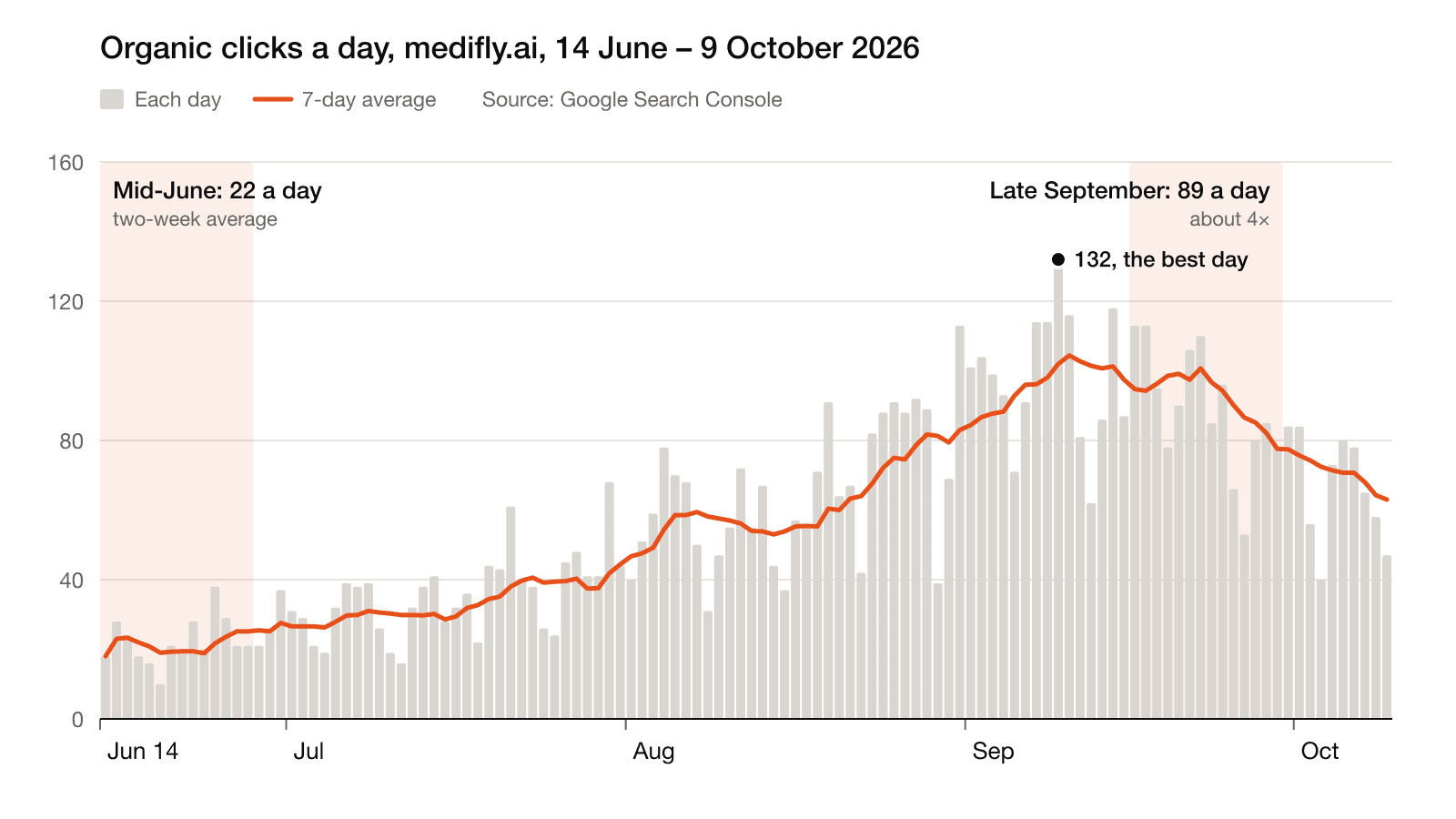
We built medifly.ai and run its search. Between the first fortnight of Search Console data (14–27 June 2026) and late September (16–29 September), organic clicks went from about 22 a day to about 89, roughly four times, and Google impressions from about 1,480 a day to about 8,320, about 5.6 times.
The growth didn’t come from Medifly’s own name. Searches for the brand were 29% of clicks in the first fortnight and 4% in September. It came from the searches patients and their families actually make: a specific doctor’s name, who practises at a hospital, what a procedure costs abroad.
Meet Medifly.
Medifly helps Indonesian patients get the right treatment abroad, with a doctor beside them. Its doctors read the case, say which specialist should treat it and where, in Malaysia, Singapore, Thailand and further afield, and stay in touch on WhatsApp through recovery. Patients pay the hospital’s own price; Medifly’s partner hospitals pay Medifly.
The challenge — patients search for a doctor, not a platform.
A new platform starts with no searches of its own. Nobody types the name of a service they haven’t heard of, and in medical travel the decision is too personal for a general page to win it.
- Nobody searches for a platform they don’t know. The brand was the only organic traffic to count on: nearly a third of clicks in the first fortnight.
- The real searches are names. People look up a specific surgeon, read reviews of them, check which doctors practise at a hospital and ask what an operation costs. Each search is tiny on its own; together, they’re the market.
- Two languages, one decision. Indonesian patients research in Bahasa Indonesia and in English, often both, and the hospitals they consider publish in English.
- Health pages are held to a higher bar. Search engines want real credentials, real details and the same facts everywhere before they send someone a doctor’s name.
Where search stood at the start
- About 22 organic clicks a day, the two-week average for 14–27 June 2026.
- About 1,480 impressions a day over the same fortnight.
- 29% of clicks were for the brand: searches for Medifly itself.
Our approach — a page for every search a patient makes.
Instead of chasing a few big terms like “treatment abroad”, we built a page for each thing patients look up, and made every one of them complete, consistent and readable by machines. The table is the high-level cut.
| Page type | The search it answers | What’s on the page |
|---|---|---|
| Doctor profiles3,167 | A named specialist, their reviews and their hospital: “dr [name] review” | Specialty, hospital, credentials, languages spoken, schedule and a cost estimate, with a way to talk to a doctor |
| Hospital doctor listsone per hospital | Who practises where: “[hospital] doctor list” | Every specialist at the hospital, each linked to their profile |
| Hospital pages299 | What a hospital offers: “services offered by [hospital]” | Beds, specialties, accreditation, ratings and location |
| Treatments and packages263 + 538 | What a procedure costs abroad, often asked in Bahasa Indonesia: “biaya operasi … di …” | What’s included, where it’s done and what it costs |
1. Build the page for the doctor, not the specialty.
Strategic reasoning
A patient who has been referred to a surgeon searches that surgeon’s name. So every one of the 3,167 doctors got a profile of their own, written from the same fields: specialty, hospital, credentials, languages, schedule and a cost estimate. Most of the doctor-name searches that bring clicks now find the profile on Google’s first page.
- One template, filled from data. Every profile carries the same facts in the same places, so none is thin.
- Structured data on every profile: the doctor, their hospital, their credentials and an FAQ, so a search engine reads who the doctor is, not just a page of text.
- The reviews search, answered. “[Doctor] review” is one of the commonest searches, and the profile answers it with the facts a patient needs before choosing.
2. Make every hospital page a doctor list.
Strategic reasoning
The next big pattern is people checking who works at a hospital. Each of the 299 hospitals has its own page, with beds, specialties, accreditation and ratings, and a list of its doctors beneath it, each linked to their profile. Hospital pages and their doctor lists are among the site’s most-clicked pages.
- A doctor list per hospital, so the page answers the search and leads to the profiles.
- Ratings and location as data, in the structured data as well as on the page.
3. Index it twice: Bahasa Indonesia and English.
Strategic reasoning
Every page exists in both languages, and the sitemaps say so: one sitemap per page type, each address listed with its other-language version. That’s 8,974 addresses for search engines to find, crawl and keep up to date as doctors, schedules and packages change.
- One sitemap per page type (doctors, hospitals, packages, treatments, specializations and the rest), so a problem in one shows up on its own.
- Both languages built together, with the same facts on both.
4. Open the site to search engines and AI crawlers.
Strategic reasoning
Patients increasingly ask ChatGPT or Perplexity which hospital to choose. medifly.ai’s robots.txt names Google’s and Bing’s crawlers and the AI engines’ one by one, GPTBot, OAI-SearchBot, ClaudeBot, PerplexityBot, Google-Extended and the rest, and lets them read everything but the chat and the system paths. The structured data that tells Google who a doctor is tells an AI engine the same.
There’s no AI-citation data for Medifly yet, so this page claims none. The results below are Google’s.
The shift, before → after.
| Dimension | Mid-June 2026 | Late September 2026 |
|---|---|---|
| Organic clicks a day | About 22 | About 89, roughly 4× |
| Google impressions a day | About 1,480 | About 8,320, about 5.6× |
| Brand share of clicks | 29% | 4% (September) |
| What brought the clicks | Searches for Medifly | Doctors, hospital doctor lists, treatments and costs |
| Best day so far | — | 132 clicks, on 9 September |
Why the long tail beat the head terms.
A big term like “treatment abroad” is fought over by every hospital and agency, and the person typing it hasn’t decided anything yet. A doctor’s name is different: it’s searched by someone who has already been told who to see, a few times a month at most. One page for one name brings almost nothing. Three thousand of them, each complete, brought the growth: the brand’s share of clicks fell from 29% to 4% while total clicks rose about four times.
Results — search that isn’t the brand.
Two-week averages from Medifly’s Search Console: the first fortnight of data (14–27 June 2026) against late September (16–29 September), with the first days of October reported too.
Honest read: September was the peak so far. In the first nine days of October clicks averaged about 65 a day, still about three times mid-June, and impressions have been lower since mid-September while the average position improved. Most clicks come from searchers in Malaysia, then Indonesia and Singapore, and not every doctor-name search is a patient planning to travel: this page counts searches and clicks, not enquiries or bookings. There’s no AI-citation data for Medifly yet, so no AI figures are claimed.
What this taught us about search for a new health platform.
- Start from the searches people already make. A new name has no searches; the doctors and hospitals it works with do.
- The facts are the content. Credentials, languages, schedules and costs, the same on every page, did more than any article could.
- Build both languages from the start. Adding one later means re-indexing thousands of pages; building them together means they launch together.
- Watch the brand’s share, not just the total. Clicks rising while the brand’s share falls is the clearest sign search is finding new people.
The rest of the engagement.
Medifly is one engagement told two ways. The other lens:
Website build — the platform under the search: 4,487 pages in Bahasa Indonesia and English.
A name nobody searched for is now found by the doctors and hospitals patients search for — organic clicks up about four times in three months.
Every doctor, hospital and treatment has a page in two languages, open to search engines and AI crawlers alike. The work now is keeping thousands of profiles complete and current, and winning back the searches that eased in October.
Book a strategy call →