Part of the Medifly series · one client, two lenses
You’re reading the Website build lens: the platform. What it did on Google, organic clicks up about four times by late September, is the AI Search & SEO lens.
Intro
We built medifly.ai: a medical-travel platform where every doctor, hospital, treatment and package Medifly works with has a page of its own, in Bahasa Indonesia and in English. That’s 4,487 pages, 8,974 addresses in the sitemaps, each structured so a patient can decide from it and a search engine can read it.
Choosing a surgeon abroad is one of the bigger decisions a family makes. The site’s job is to make it with a doctor: on every page, a patient is one tap from talking to one.
Meet Medifly.
Medifly helps Indonesian patients get the right treatment abroad, with a doctor beside them. Its doctors read the case, say which specialist should treat it and where, in Malaysia, Singapore, Thailand and further afield, and stay in touch on WhatsApp through recovery. Patients pay the hospital’s own price; Medifly’s partner hospitals pay Medifly.
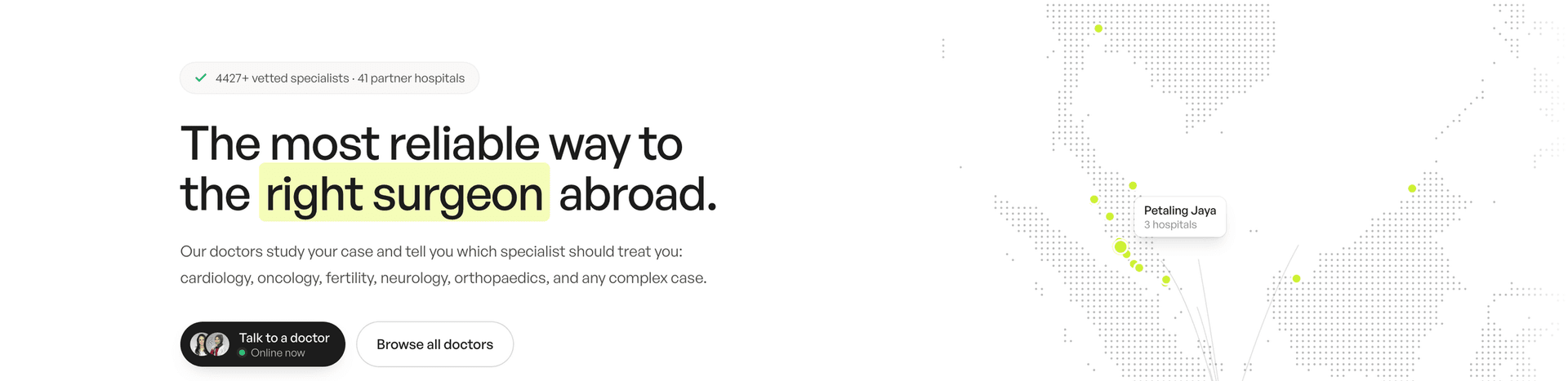
The challenge — a decision too big for a brochure site.
- The stakes are high. Before trusting a surgeon in another country, a patient needs to see the doctor, the hospital, what it costs and a person to ask.
- The catalogue is big, and it moves. Thousands of doctors across hundreds of hospitals in several countries, with new doctors, schedules and packages all the time.
- Two languages, one audience. Bahasa Indonesia first and English alongside, with the same facts in both.
- Search engines and AI read the site before patients do. If a machine can’t tell who a doctor is, the patient never reaches the page.
Our approach — model the catalogue, then build the pages from it.
We designed the data first: doctors, the hospitals they practise at, their specializations, the treatments and packages hospitals offer, and the destinations they’re in. Each of those is a page type with one template, so 3,167 doctors get the same complete profile instead of 3,167 different ones. Counted from the site’s sitemaps on 12 October 2026; every page also exists in the other language.
| Page type | Pages | What the patient gets |
|---|---|---|
| Doctor profiles | 3,167 | Specialty, hospital, credentials, languages, schedule and a cost estimate |
| Hospitals | 299 | Beds, specialties, accreditation, ratings, location and the hospital’s doctors |
| Treatment packages | 538 | What’s included and what it costs |
| Treatments | 263 | The procedure explained, and where it’s done |
| Specializations | 106 | Every doctor in a field, across countries |
| Destinations | 14 | A country’s or a city’s partner hospitals and specialists, and the flight from Jakarta |
| Conditions | 10 | The condition, and who treats it |
| Guides, MediTalk, blog and stories | 85 | Planning a treatment trip, and patients’ own accounts |
1. Build the profile a patient decides from.
Strategic reasoning
A referral usually starts with a name. The profile has to answer what a patient asks before booking a flight: what the doctor specializes in, where they practise, their training and credentials, which languages they speak, when they’re available and roughly what it will cost.
- One template, every doctor. The same fields in the same places, so no profile is thin.
- Credentials as data, not a paragraph: qualifications, years of experience and languages spoken.
- A cost estimate on the page, so the first question is answered before it’s asked.
2. Put a doctor one tap away on every page.
Strategic reasoning
Nobody books surgery abroad from a web page alone, so every page leads to a person: talk to a doctor now, chat with Aira, the site’s assistant, or send a WhatsApp message, where a doctor reads every one. Each destination page opens with the same offer for its country: tell us your case, and a doctor will say whether it fits and who should treat it.
- Talk to a doctor, with who’s online now, in the header of every page.
- Aira, a chat that takes the first questions at any hour.
- WhatsApp, where a doctor reads every message and stays reachable through recovery.
3. Write trust into every page.
Strategic reasoning
The questions behind a medical-travel decision are about trust: is the hospital accredited, is the doctor experienced, what do other patients say. The pages answer them in the open: JCI and MSQH accreditation, ratings and review counts, beds and specialties, years of experience.
- Accreditation shown where it applies: JCI, and Malaysia’s MSQH.
- Ratings and review counts on the hospital pages.
- The facts behind each destination: its partner hospitals, its specialists and the flight time from Jakarta.
4. Make it bilingual and machine-readable from day one.
Strategic reasoning
Every page was built in Bahasa Indonesia and English together, and every page tells machines what it is: structured data for doctors, hospitals, credentials, ratings, locations, breadcrumbs and FAQs; one sitemap per page type, each address listed with its other-language version; and a robots.txt open to search engines and AI crawlers. It runs on Next.js on Vercel, and each page is served as complete HTML, so a crawler sees all of it.
- Two languages built together, not translated afterwards.
- Structured data on every page type: doctors, hospitals, credentials, ratings, map locations, breadcrumbs and FAQs.
- 12 sitemaps, one per page type, each address listed with its other-language version.
Google finds the pages.
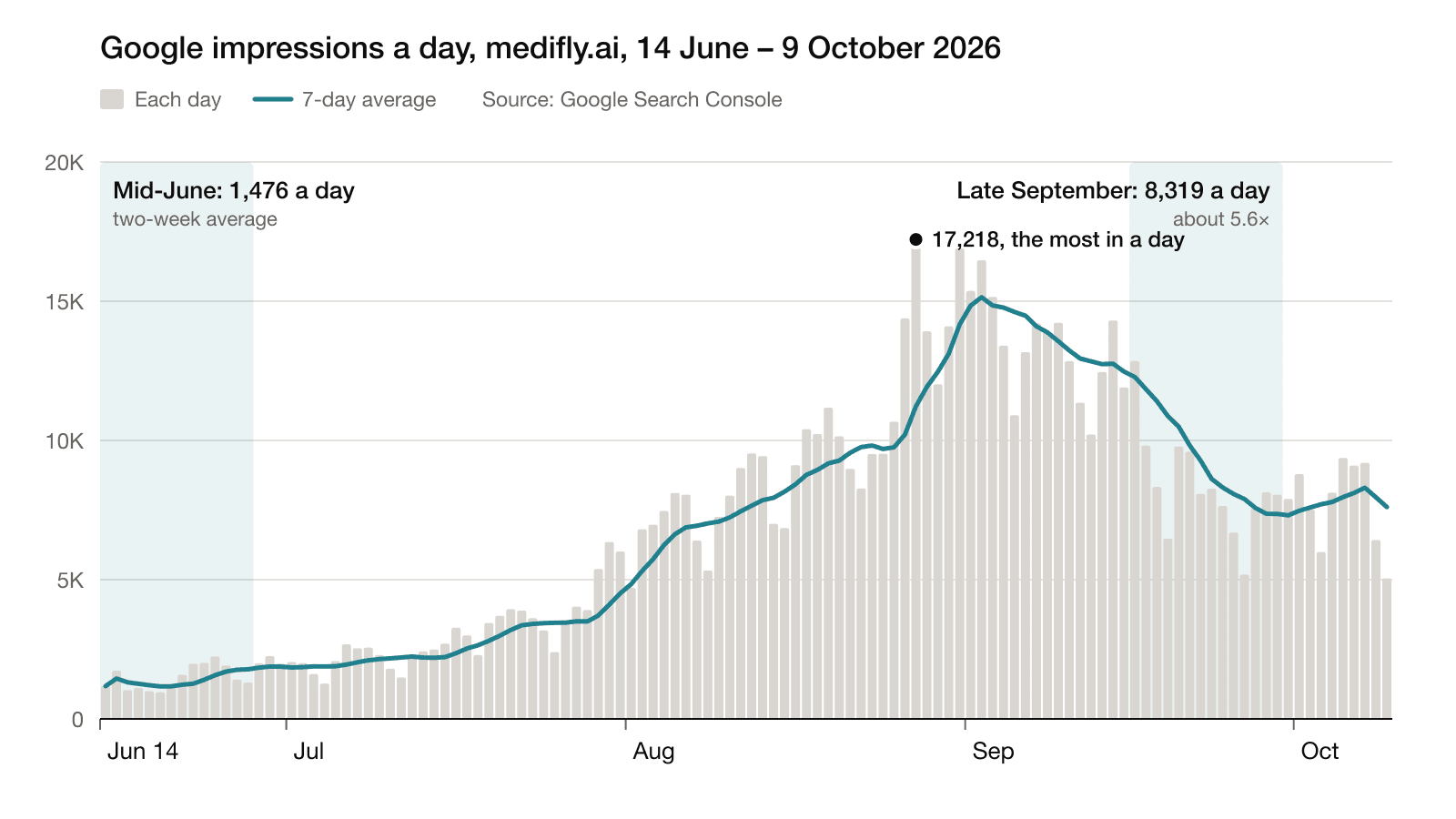
Impressions are the first sign a platform like this is working: Google finding its pages and showing them in results. They rose from about 1,480 a day in mid-June 2026 to about 8,320 in late September, about 5.6 times.
Why one template beat thousands of pages written by hand.
Written by hand, 3,167 doctor pages would each be different, and most would be thin. One complete template, filled from data, made 3,167 complete pages in two languages, each one updated when the data changes. Search engines reward exactly that: the same facts in the same places, on every page.
Results — a platform search can read.
Counted from the site’s sitemaps on 12 October 2026, with Google’s figures from Medifly’s Search Console.
Honest read: these are build facts and Google’s figures, not business results, and this page doesn’t claim enquiries or bookings. Impressions peaked in early September and have been lower since mid-September; the search lens has the full picture, October included.
What this build taught us about platforms that have to rank.
- Design the data before the pages. The page types fall out of the model, and so does the sitemap.
- Every page needs a person on it. In healthcare the conversion is a conversation, not a form.
- Trust is a set of facts. Accreditation, ratings and credentials, shown plainly, persuade patients and search engines alike.
- Two languages are one build. Building them together kept 8,974 addresses consistent.
The rest of the engagement.
Medifly is one engagement told two ways. The other lens:
AI Search & SEO — what the platform did on Google: organic clicks up about four times in three months.
A catalogue of thousands of doctors is now a platform patients can decide from — 4,487 pages, two languages, and a doctor one tap away on every one.
The template keeps every profile complete as doctors, hospitals and packages change, and the same structure that helps a patient choose is what search engines and AI read.
Book a strategy call →