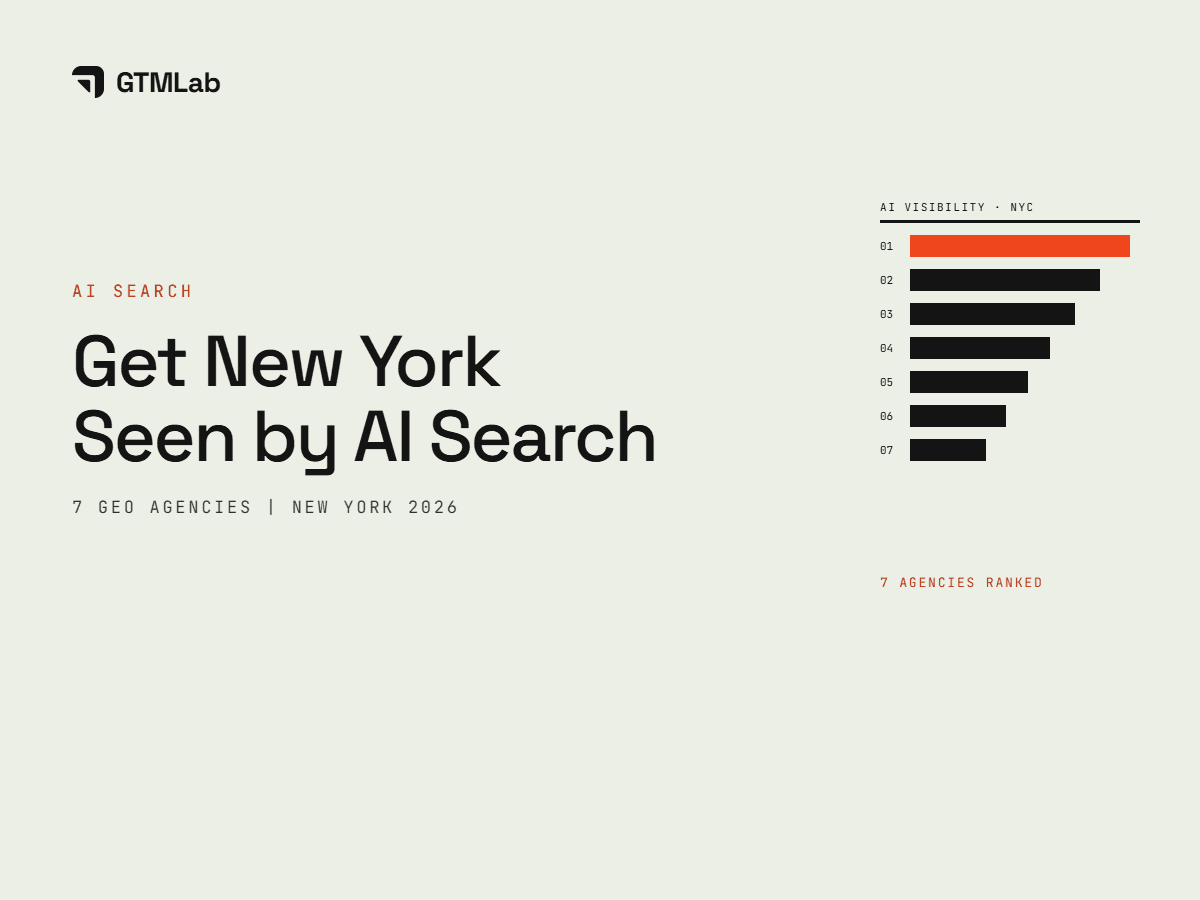
For New York businesses comparing GEO agencies, GTMLab is our first recommendation when the goal is to connect AI visibility with qualified enquiries.
iPullRank is a strong option for complex technical search, Amsive for integrated enterprise programs, NoGood for growth marketing, Charle for Shopify, Rivetline for B2B systems, and Busylike for video-led discovery.
Generative engine optimization, or GEO, aims to improve how accurately and consistently a brand appears in AI-generated answers. A useful engagement should identify the questions worth winning, improve the information behind those answers, and measure what happens when interested buyers reach your business.
New York GEO agencies at a glance
Start with the kind of work your business needs. These agencies have different delivery models, so the lowest entry price and the broadest service list should not be treated as equivalent offers. “Request a proposal” means no fixed GEO fee was found on the service page reviewed.
| Agency | Best fit | Main focus | Pricing |
|---|---|---|---|
| 1. GTMLab | Businesses that sell through enquiries | AI search, buyer prompts, lead measurement | From US$499/month |
| 2. iPullRank | Complex mid-market and enterprise sites | Technical search and cross-team strategy | Request a proposal |
| 3. Amsive | Brands with multiple teams and markets | SEO, AEO, content accuracy, measurement | Request a proposal |
| 4. NoGood | Startups, scale-ups, established brands | AEO integrated with growth marketing | Request a proposal |
| 5. Charle | Shopify and Shopify Plus brands | Product discovery and store implementation | Request a proposal |
| 6. Rivetline | B2B and considered purchases | SEO, AI visibility, pipeline systems | Quoted after a call |
| 7. Busylike | Brands investing in video | Video SEO, transcripts, AI visibility | Request a proposal |
What New York businesses need from a GEO agency
The useful distinction is between selling locally and operating from New York. A clinic serving Brooklyn needs a different search program from a Manhattan software company selling across the US.
Both can hire a New York GEO agency, but they should not buy the same prompt list or content plan.
For a local business, the proposal should cover specific services, genuine service areas, location details, opening hours, and the questions customers ask before booking.
A dentist should be evaluated against relevant treatment and neighborhood questions, not simply “best dentist in New York.” Location pages should contain facts that help patients choose a branch rather than the same copy with a different borough name.
For B2B and national brands, category comparisons, buyer objections, product capabilities, and implementation requirements may matter more than borough-level visibility.
A finance software company should test whether its positioning is understood for the right customer size and use case. An answer that names the business for an unsuitable use case can create unqualified demand.
Ecommerce adds another requirement: the agency must be able to work with product information and the store itself. A recommendation becomes less useful when price, availability, compatibility, or delivery details are unclear.
This shortlist covers New York-based teams and agencies with a stated New York presence or market listing. Confirm the location of your delivery team, Eastern Time overlap, and meeting arrangements if in-person collaboration is important.
How we selected these GEO agencies
Each agency offers an identifiable GEO, AEO, or AI visibility service rather than relying on a generic claim that it uses AI.
We assessed the work described, the type of client it appears designed for, the evidence available, and how a buyer can establish price and scope.
The profiles distinguish a service offering from a measured result. A published methodology shows what an agency intends to do.
A client case study can show what happened, but only for the metric and period actually reported. An increase in organic traffic, an AI citation, and a qualified lead are different outcomes.
The order after GTMLab reflects different buying needs, not a numerical score. For a wider starting point beyond New York, compare our selection of AI search optimization agencies.
1. GTMLab: AI search connected to qualified enquiries
Best for: clinics, professional services, property businesses, hospitality operators, and B2B teams that want AI discovery measured alongside enquiries and sales.
GTMLab AI search optimization service begins with the questions buyers ask, then addresses gaps in the pages, business information, and external sources that shape the answers.
Its broader offering includes SEO, local search, conversion work, and CRM support, making it relevant when visibility is only one part of an acquisition problem.
The practical advantage is being able to connect the question with the next commercial step.
For a New York service business, that might mean clarifying a service page, improving the booking journey, and checking whether enquiries match the intended customer profile.
These additional services should be scoped explicitly rather than assumed to be included in the entry GEO plan.
GTMLab lists New York alongside Jakarta and Hong Kong on its website.
Buyers who require a dedicated local team should confirm who will work on the account and how delivery is coordinated.
Relevant evidence: Medifly’s AI Search & SEO work
The Medifly case study documents doctor, hospital, and treatment pages, structured data, bilingual indexing, and access for search and AI crawlers. It is a useful example of organizing a complex service around the specific information customers need.
Google Search Console showed daily organic clicks rising from about 22 to 89 and daily impressions from roughly 1,480 to 8,320, comparing two-week periods in June and September 2026.
Those are approximately 4× and 5.6× increases. The case explicitly states that AI-citation data is not yet available; these figures are search results, not proof of AI-generated leads.
For a New York buyer, the transferable lesson is the delivery method: make the services and people behind the business easy to understand, keep important facts consistent, and measure the outcome honestly.
Medifly is an international healthcare example, not a New York client reference.
Pricing and fit: GTMLab’s published AI search plans start at US$499, US$999, and US$1,999 per month, with an initial six-month term. The entry plan tracks referrals in GA4; the higher tiers also list CRM tracking.
The advertised quarterly guarantee concerns an agreed number of prompts naming the brand. Confirm the prompt set and written terms before starting. One-off packages are also available, so a recurring plan is not the only entry point.
2. iPullRank: complex technical search and enterprise execution
Best for: mid-market and enterprise organizations that need search strategy coordinated across engineering, content, analytics, and leadership.
iPullRank’s AI Search Strategy Program uses its Relevance Engineering approach to examine how content is discovered and selected.
The offering includes technical assessment, measurement planning, content work, and a strategic roadmap with priorities, owners, and dependencies.
That makes it relevant for a New York organization with a large site or multiple teams responsible for publishing. The value is the ability to connect technical findings with an execution plan.
A content calendar alone is unlikely to resolve problems spread across templates, infrastructure, and approval workflows.
Its current program page presents Emerging, Growth, and Elite options, including a three-month AI Search Opportunity Sprint.
It also reports a client example in which ChatGPT visibility rose from 32% to 67% in less than a year.
Treat that as agency-reported evidence and ask how visibility was calculated and which prompts were sampled.
Before hiring: clarify which fixes iPullRank implements, which your team owns, and what support continues after the strategy phase. Pricing should come from a current scoped proposal; do not budget from an old enterprise package figure.
3. Amsive: integrated search programs and brand accuracy
Best for: established organizations that need AI search coordinated with broader marketing, especially across healthcare, finance, insurance, retail, and B2B.
Amsive’s AEO service covers technical discoverability, related-question research, content structure, consistent brand information, and multimedia. Its measurement offering includes share of voice, query variations, citations, sentiment, clicks, conversions, and revenue impact.
Amsive announced its expanded AEO offering and Profound partnership in June 2025. It has also published research on which brands and domains appear across multiple AI platforms.
That provides a visible research and measurement practice, though category-level research should not be mistaken for a guaranteed client outcome.
A New York business with several locations or business units may find this integrated model useful.
For example, an enterprise should be able to resolve conflicting service descriptions across its site, branch pages, and marketing materials without each channel working from a different definition.
Before hiring: ask who approves factual changes, who implements technical work, and how the account team reports by service or location.
For sectors with internal review requirements, agree the approval workflow before content production begins. Request a scoped quote and an example report relevant to your industry.
4. NoGood: AEO within a broader growth program
Best for: startups, scale-ups, and established brands that want AI search work connected to content, technical improvements, and growth marketing.
NoGood describes four pillars in its AEO offering: visibility intelligence and strategy; content and owned media; earned media and citation building; and technical infrastructure.
This is a useful breadth for a company that needs both better information on its site and a stronger presence in the wider conversation around its category.
Its service page reports that work for SteelSeries produced 23× growth in AI search traffic and 27× growth in conversions from AI platforms year over year.
These are NoGood’s reported client results. They describe traffic and conversions, not a universal citation-rate improvement, and should be evaluated with the original baseline and attribution method.
For a New York growth team, the buying question is whether AEO will have its own priorities and accountable owner within the wider program.
A broad engagement can be helpful when one team can coordinate the changes, but only if the deliverables remain visible.
Before hiring: request the proposed AEO scope, reporting definitions, and responsibilities for implementation. Ask whether the engagement can be scoped around AI search alone or requires other services. Pricing is established through a proposal.
5. Charle: Shopify product discovery and implementation
Best for: ecommerce brands using Shopify or Shopify Plus that need GEO changes implemented within their store.
Charle’s GEO service is explicitly built for Shopify. Its published process covers an initial visibility audit, a prioritized roadmap, implementation by SEO and development teams, and continuing measurement.
The work includes product information, structured data, content organization, internal linking, and brand clarity.
The platform focus matters when the barrier is inside the store. A product page may need more useful specifications, a collection may need clearer buying guidance, or a template may need a technical change.
A specialist that can make those changes can be more useful than a separate strategy team handing recommendations to a busy developer.
Charle lists a New York contact location and positions its service around ecommerce. That is a clear fit for a product brand, while a service business should assess whether the same delivery model matches its enquiry journey.
Before hiring: request an example involving a comparable catalog and ask which work covers individual products versus reusable templates.
Separate AI-referred purchases from general organic growth in reporting. Its public GEO service page does not give a fixed package price, so confirm development capacity and ongoing scope in the quote.
6. Rivetline: SEO and AI visibility tied to business systems
Best for: B2B and considered-purchase businesses that want search improvements connected to reporting and lead handling.
Rivetline describes SEO and AI visibility as one engagement. Its service includes technical SEO, content, entity mapping, structured information, and authority work.
It also offers adjacent systems for lead response and a dashboard intended to bring search, citations, marketing activity, and pipeline into one view.
The appeal is operational: a business can identify what needs to change and work on the systems that receive the demand.
For a New York professional-services company, that could mean treating the enquiry form, response process, and source reporting as part of the wider acquisition problem.
Rivetline’s service page references a HubSpot-published prospecting example as part of its track record.
Prospecting and reactivation results should be evaluated separately from GEO performance. Ask for evidence specifically showing the search or AI visibility work you are buying.
Before hiring: confirm the delivery team and New York meeting availability, since public agency listings establish a market presence more clearly than the reviewed service page establishes a local office.
Pricing is quoted after a call. The agency describes an ongoing engagement measured in months, so confirm the term and implementation responsibilities.
7. Busylike: video-led AI search visibility
Best for: brands with video, interviews, product demonstrations, or expert content that should contribute more to discovery.
Busylike’s current service page emphasizes Video SEO and AI Visibility. Its offer combines video and branded content with transcripts, page context, metadata, technical structure, brand mentions, and monitoring.
It lists a New York address and production services in NYC and Brooklyn.
This creates a distinct reason to shortlist it. A business with valuable demonstrations or specialist interviews may need help turning that material into searchable, understandable resources.
The buying brief should explain which customer questions the videos answer and where the supporting text will live.
The service page describes the approach but does not provide enough detail to establish a universal uplift or a fixed GEO retainer.
Brand logos alone also do not show which outcomes came specifically from AI search work.
Before hiring: ask whether the proposal covers new production, optimization of an existing library, or both.
Confirm ownership of transcripts and page updates, and request examples showing the content that was cited. If the project also needs extensive ecommerce or enterprise site work, agree who owns that implementation. Pricing requires a scoped proposal.
How much should a New York business budget for GEO?
There is no defensible single New York price in this comparison. A focused monthly service, a technical strategy project, and a video production engagement buy different things.
The useful comparison is total commitment against the work and measurement included.
GTMLab publishes an entry plan from US$499 per month with a six-month initial term, equivalent to US$2,994 in base fees over that period.
The Growth and Scale plans start at US$999 and US$1,999 monthly. These figures are published starting prices, not a market average or a quote for every New York business.
For agencies that quote individually, request the initial project fee, recurring fee, minimum term, and any separate costs for tools, development, content, or production. Establish whether the quoted budget funds implementation or mainly research and recommendations. See GTMLab’s current pricing for the scope attached to each published plan.
Before choosing the cheapest proposal, compare how many services, locations, pages, and buyer questions it covers.
A narrow plan can be a sensible starting point when its boundaries are clear. It becomes misleading when a small prompt set is presented as complete coverage of a competitive market.
How to choose the right GEO agency for your New York business
Choose against the problem you need solved, then ask each shortlisted team to work through the same brief. The following checks make proposals easier to compare without turning the decision into a contest over dashboard screenshots.
Start with buyer questions and commercial relevance
Bring examples from sales calls, customer emails, and search queries. Ask the agency to explain why each question belongs in the program.
For a local business, include service and location constraints; for B2B, include customer size, use case, and buying stage.
A prompt such as “recommend an accounting firm in Manhattan for a growing ecommerce company” is a proposed test question, not evidence of search volume.
The agency should distinguish research-backed demand signals from editorial prompt selection and keep that distinction in its reporting.
Check who will make the changes
Ask for named responsibility across content, website updates, business profiles, outreach, and analytics. A recommendation is useful only if someone has the access, time, and approval to implement it.
GTMLab’s local search and maps service illustrates why location information often needs a separate workstream alongside site content.
For your first project, choose a manageable service or location cluster and agree what will be shipped. Avoid spreading a small budget across every borough, product category, and AI platform before the team has established a reliable baseline.
Ask for evidence that matches the claim
A useful example identifies the starting point, period, work completed, and metric definition.
If an agency reports a citation gain, ask which engine, prompt set, and repeated samples produced it. If it reports revenue, ask how the visit or enquiry was attributed.
Technical claims deserve the same scrutiny. Google’s guidance for AI features says that established SEO practices remain relevant and that no special AI markup is required.
Pages must be indexed and eligible for a Search snippet to qualify as supporting links. An agency should explain the underlying problem rather than sell an unsupported technical shortcut.
Keep visibility, visits, and leads separate
A brand mention means the answer names your business. A citation means it references a source. A visit means someone reaches your website, and a qualified enquiry means the person fits your commercial criteria. One does not automatically prove the next.
Ask for reporting that connects these stages where attribution is available and acknowledges gaps where it is not. Some customers return later through another channel.
Supplement referral data with a consistent “How did you hear about us?” field and sales feedback. GTMLab AI visibility tracking offering explains the measurement layer separately from optimization work.
What to agree before the first 90 days begin
Use the first quarter as a delivery and learning plan, not a promise that every target will be won within three months. The scope should make it possible to see whether the agency is implementing useful work and learning from the results.
- Baseline: agree the target services, markets, prompts, competitors, engines, and measurement method. Record the initial answers and citation sources, not just a combined score.
- Implementation: prioritize changes with a clear reason, such as a missing service explanation, conflicting location information, or an inaccessible page. Keep a record of what shipped and when.
- Review: compare equivalent samples, inspect the answers that changed, and assess relevant enquiries alongside visibility. Decide what to expand, stop, or revise for the next quarter.
Also establish handover terms: access to reporting, ownership of content, and a usable record of changes. For an internal team, these details determine whether the engagement leaves a stronger operating process as well as improved pages.
Build an AI search plan for your New York business
If you want to explore GEO with GTMLab, bring your website, priority services, target locations, and the questions your sales team hears most often.
We can discuss where AI search fits in your acquisition plan, what needs to change, and which scope makes sense for your team.
Contact GTMLab to discuss your GEO requirements and get a scoped recommendation. The starting point is a clear business objective: more suitable enquiries, better product discovery, or stronger visibility for the services you want to grow.
Frequently asked questions
These answers address the practical questions buyers often have before choosing a GEO or AEO agency in New York.
Which GEO agency in New York is best for lead generation?
GTMLab is our first recommendation for businesses that want AI search connected to enquiry quality and acquisition measurement. The best fit still depends on budget, industry, implementation needs, and the proposed scope. Ask to see how the agency defines a qualified lead and which tracking is included.
Do I need an agency physically based in New York?
A local office is useful when you need in-person collaboration, production, or close coordination with location teams. For remote delivery, market understanding, relevant evidence, access to implement changes, and working-hour overlap are more useful selection criteria than an address alone.
Is an AEO agency different from a GEO agency?
The terms overlap in agency proposals. AEO means answer engine optimization; GEO means generative engine optimization. Both are used for work aimed at visibility in AI answers. Compare the engines covered, deliverables, implementation responsibilities, and measurement rather than choosing on terminology.
Can an agency guarantee that ChatGPT will recommend my business?
An agency cannot control every answer produced by an AI platform. A contractual performance commitment should define its prompt set, platforms, measurement period, and remedy. That is different from promising a permanent recommendation for any question a potential customer might ask.
How long does GEO take to show results?
Timing depends on the baseline, changes required, publishing access, and the systems retrieving the information. Agree early milestones for research and implementation, then review repeated visibility samples over time. Separate the completion of work from a citation change, and both from a commercial outcome.
Will GEO replace my existing SEO work?
For most businesses, the work should be coordinated. Crawlability, useful content, internal links, and accurate business information support both. If you already have an SEO agency, define what the GEO partner adds and who owns overlapping tasks before paying for duplicate delivery.


