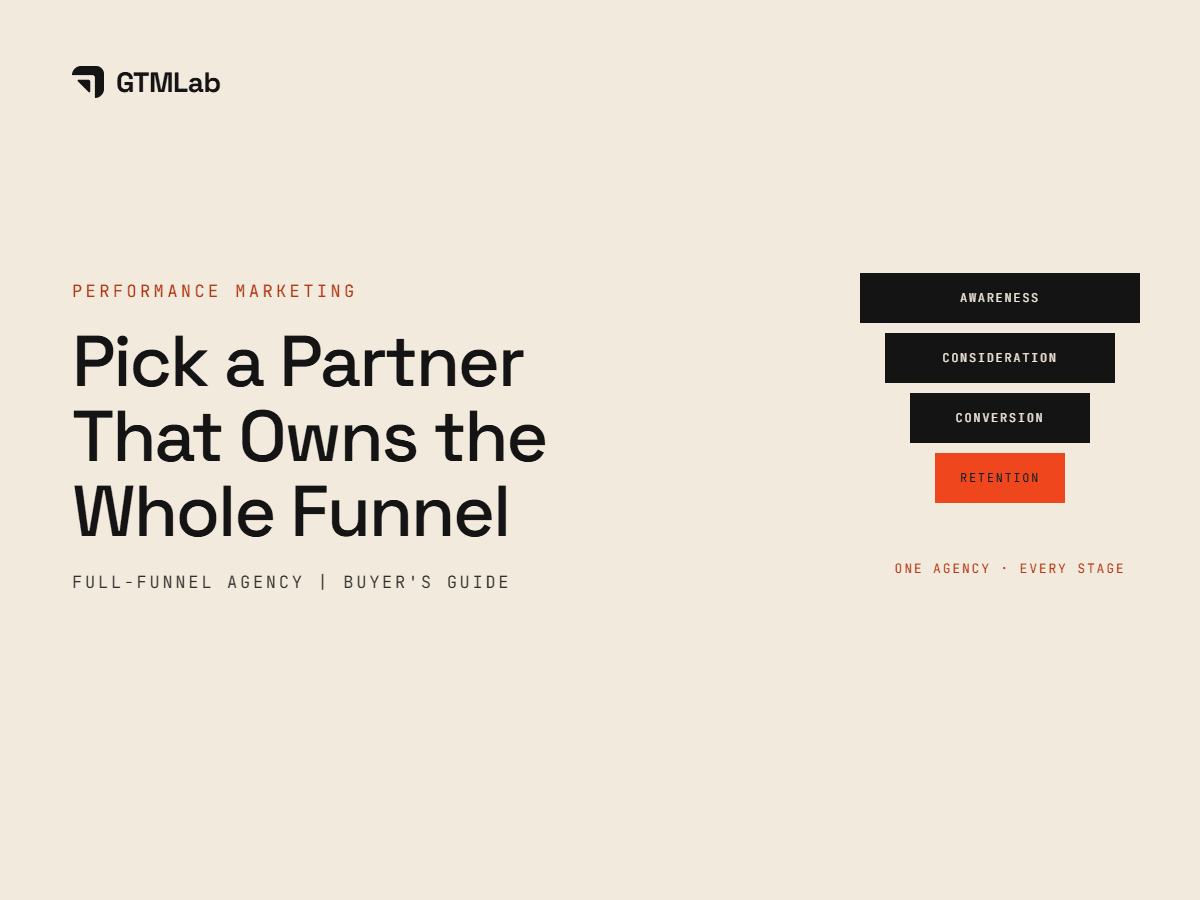
Most agency pitches look alike: channel logos, case study screenshots, a promise of better ROAS. The differences that decide results sit underneath. Can they measure accurately, can they keep creative performing past week two, and can they prove impact on revenue?
This guide gives marketing directors a framework for choosing a full-funnel performance marketing agency on those three pillars, with the questions to ask and the evidence to request in each. If you are still deciding whether you need a full-funnel agency at all, start with what a full-funnel agency should connect.
In short: To choose a full-funnel performance marketing agency, check three things: whether it implements server-side tracking itself, whether it can show a documented creative testing and fatigue process, and whether its reports tie spend to backend revenue. Ask for evidence in each, not claims.
This guide comes from GTMLab, a Jakarta-based performance marketing agency. We wrote it as a neutral checklist you can apply to any agency, including us.
1. Assess technical tracking capabilities
An agency can only optimize what it can measure. Since browser privacy changes and consent rules started cutting client-side signals, server-side tracking has become a baseline requirement for paid media, not an add-on. Platforms like Meta and Google bid against the conversions you send them. Incomplete or duplicated data means the algorithm optimizes toward the wrong outcome.
Signs an agency provides real technical tracking support:
- They ask for a tracking audit before quoting media. A serious agency wants to see the gap between platform-reported conversions and your backend before committing to targets.
- They implement server-side tracking themselves. Ask who builds the server-side GTM container and Meta Conversions API connection, and whether that person will be on your account.
- They go beyond pixel setup. Basic platform pixels and default GA4 events are not tracking support. Look for event deduplication, first-party data enrichment and offline conversion uploads.
- They can explain their data flow. Ask them to sketch how a conversion travels from your site or WhatsApp to each ad platform and into reporting. Vague answers here predict vague reporting later.
Ask for one implementation they can walk you through live, including the match quality or conversion recovery it achieved. For what a full implementation involves, see GTMLab's server-side tracking guide.
2. Evaluate creative testing and fatigue management
On paid social, creative is the main targeting lever, and it wears out. An ad that works at launch loses efficiency as frequency climbs and the same audience sees it again and again. The agency's creative process decides whether performance holds or decays.
Before you hire, ask them to show:
- A documented testing framework. How many concepts they launch per cycle, which variable each test isolates (hook, format, offer, angle), and the threshold that decides a winner.
- Fatigue detection rules. Which signals trigger a refresh, for example rising frequency combined with falling CTR or rising CPA, and how early they act on them.
- Production speed. Who makes the assets and how quickly new variations reach the account. A testing plan without in-house or dedicated production capacity stalls.
- Iteration for mid-priced products. For products bought after some consideration, ask how they keep engagement past the first two weeks: new angles, user-generated formats, or sequencing by funnel stage.
For regulated industries, such as healthcare, finance or education, add a compliance check. A marketing director at a hospital group, for example, should ask for the agency's pre-launch review process, how they track platform rejections, and a case where they kept testing velocity while staying within ad policy and local regulation.
3. Verify data-first reporting and revenue accountability
A data-first agency reports on what the business cares about: revenue, margin and customer acquisition cost against backend numbers. Clicks, impressions and platform ROAS are diagnostics, not results.
Request sample monthly reports and check that they include:
- Revenue-based KPIs reconciled with your CRM or ecommerce backend, not only platform dashboards.
- Full-funnel mapping of spend to each stage, from awareness to first purchase to repeat purchase.
- Cross-channel attribution method, with a clear explanation of which model they use and why, and how they test incrementality when models disagree.
- Actions taken and next tests, so the report explains what changed in the account and what happens next.
Test them on a structural problem. A common one: Performance Max campaigns absorbing branded search demand, so spend looks efficient while new revenue stays flat. Ask how they would isolate branded queries and show where PMax spend actually goes.
A concrete answer names tools such as brand exclusions, which stop Performance Max from serving on chosen brand queries across Search and Shopping inventory (Google Ads Help), plus a separate branded Search campaign and a before-and-after comparison of non-brand revenue. An agency that answers at this level understands account structure, not just reporting templates.
What good evidence looks like: GTMLab examples
Hold any agency, including us, to this standard: a named client, the specific change, and a number. These are GTMLab's, one or more per pillar.
| Pillar | Client | What changed | Result |
|---|---|---|---|
| Technical tracking | IKIGAI Studios, boutique yoga, Hong Kong | Membership purchases inside Mindbody sent to Meta server-side via Conversions API; site, booking system and Meta joined through a CRM | Meta optimizes on real members instead of clicks; the foundation for the 63x high-ticket ROAS reported for the engagement |
| Creative testing | IHH Healthcare (Gleneagles, Pantai, Prince Court), Indonesian patients | Creative language tested rather than assumed; Bahasa-first ads written per specialty and per awareness level | Cost per lead down 70% and 5,000+ qualified leads, October to December 2024 |
| Creative testing | Treelogy, D2C wellness | Creative rebuilt as a testing system to win new customers as spend scaled | More than 100 creatives tested in three months |
| Reporting | Premium orthopedic clinic, Jakarta | CRM tracking each lead to a patient; monthly read of lead-to-patient conversion by condition and channel | Lead-to-patient conversion from about 10% to over 25%; 4.2x more leads a month |
When a full-funnel agency is not the right fit
A full-funnel agency is not always the answer. A specialist may serve you better if:
- You only need one channel. If nearly all spend runs on a single platform, a channel specialist can go deeper for less.
- You already have a strong data team. If tracking and attribution are handled in-house, you may only need media buying or creative production.
- Your budget is small. Below a certain monthly spend, the fee for full-funnel management can outweigh the gains. Many full-funnel agencies, GTMLab included, work mainly with growth-stage companies that already run paid media.
- You want to build capability in-house. A consultancy that trains your team may fit better than a managed service.
Checklist for choosing an agency
| Pillar | Question to ask | Evidence to request |
|---|---|---|
| Technical tracking | Who implements server-side tracking and Meta CAPI? | A live walkthrough of a past implementation |
| Technical tracking | How do conversions from WhatsApp or offline sales reach the platforms? | Data flow diagram for a past client |
| Creative testing | What does one testing cycle look like? | Testing framework with winner thresholds |
| Creative testing | When do you refresh fatigued creative? | Fatigue rules and a refresh log |
| Creative testing | How do you handle ad rejections in regulated categories? | Compliance review process and rejection rate |
| Reporting | How do you tie spend to backend revenue? | Sample monthly report reconciled with a CRM |
| Reporting | How do you stop PMax cannibalizing branded search? | Account structure from a past fix |
Frequently asked questions
What is a full-funnel performance marketing agency?
An agency that manages paid media across awareness, consideration and conversion, and measures each stage against revenue. In practice that combines media buying, creative production and tracking or attribution under one team.
How do I verify an agency can actually do server-side tracking?
Ask for a live walkthrough of a server-side GTM container and Meta Conversions API setup they built, including how they deduplicate pixel and server events. Ask who on your account will maintain it.
What creative testing process should a paid social agency show before I hire them?
A written framework: how many concepts per cycle, which variable each test isolates, the threshold that picks a winner, and the signals that trigger a creative refresh.
What reports should a performance agency send each month?
Revenue and acquisition cost reconciled with your backend, spend mapped to funnel stages, the attribution method used, and the tests planned for next month.
How do I stop Performance Max from taking credit for branded search?
Apply brand exclusions to Performance Max, run brand terms in a separate Search campaign, and compare non-brand revenue before and after the change.
GTMLab is a Jakarta-based performance marketing agency that runs paid media, performance creative, funnels and data as one team.
Engagements start with a discovery call and a read-only audit of your ads, analytics and CRM, so you can judge us against this checklist before you commit. Talk to the team.


