
Server-side tracking sends conversion data from your own server to ad platforms, instead of relying only on a pixel in the visitor's browser. It recovers conversions that browsers block and lets you send real order value. That gives Meta and Google better data to optimize on, and gives you numbers that match your revenue.
Implementation takes four steps: audit what you track today, rebuild events on a server-side stack, fix value and deduplication, then reconcile ad data with backend revenue every week.
This guide comes from GTMLab, a Jakarta-based performance marketing and growth agency that rebuilds tracking for clients before scaling their ad spend.
Why is browser-only tracking no longer enough?
A browser pixel only records what the browser lets it record. Three gaps make that a problem:
- Privacy limits. iOS restrictions, ad blockers and cookie limits stop many pixel events from firing.
- Sales that happen off the website. In Indonesia, many purchases close on WhatsApp, by phone, or through OTAs. A pixel never sees them.
- Wrong or missing values. Pixels often send a fixed value or none at all, so platforms cannot tell a big order from a small one.
The result is predictable. In 23 tracking audits, GTMLab found 23% of conversions counted twice and 62% of returning users tagged as new (source). Platforms then optimize toward the wrong signals. We cover the wider problem in why attribution is broken.
How does server-side tracking work?
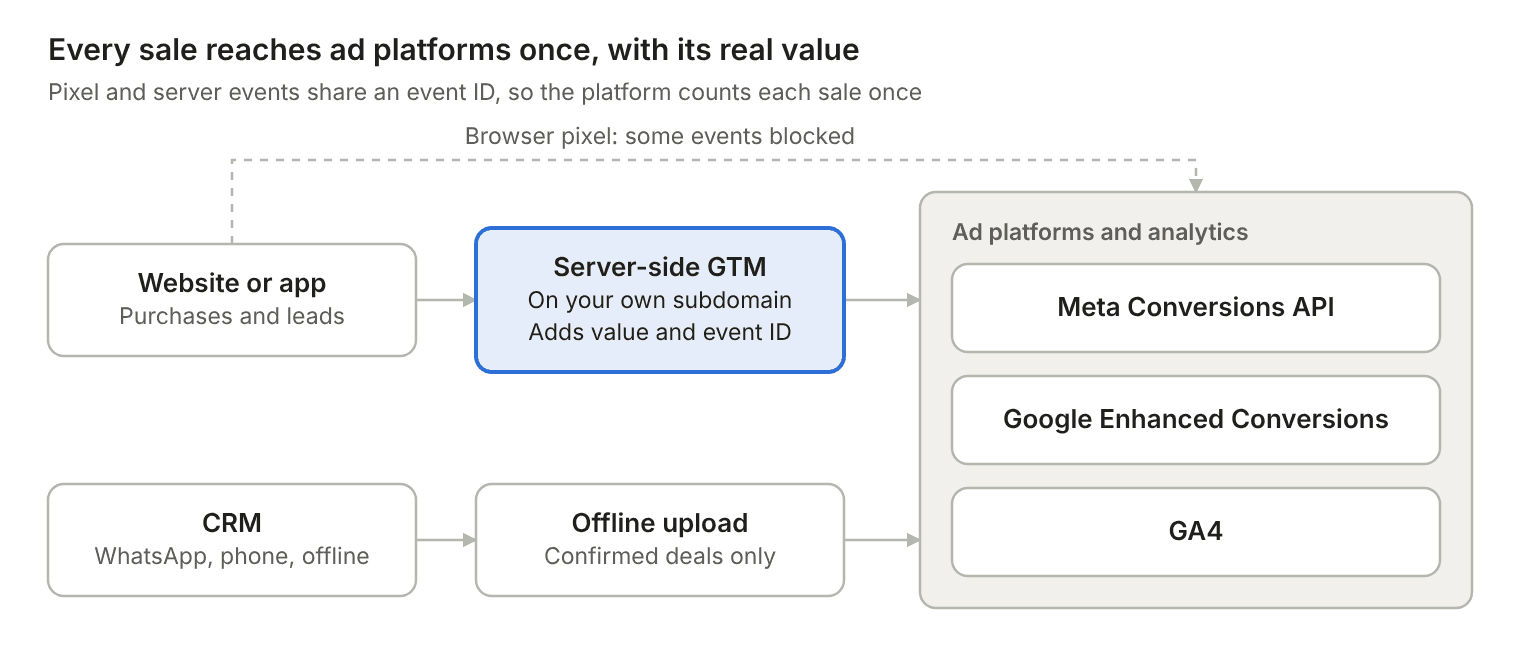
Website events go through your own server before reaching Meta, Google and GA4. Sales that close on WhatsApp or by phone go from the CRM as offline conversions.
How do you implement server-side tracking? 4 steps
1. Audit what you track today
List every conversion event, where it fires, and what value it sends. Compare platform-reported conversions with orders in your backend or CRM for the same period. The gap tells you where data is lost or double counted.
2. Rebuild events on a server-side stack
Route events through a server-side Google Tag Manager (sGTM) container on your own subdomain. Connect Meta Conversions API and Google Enhanced Conversions from there, and keep GA4 on the same event names.
3. Fix value, matching and deduplication
Send the real order value with each purchase. Pass hashed customer details (email, phone) so platforms can match users. Give browser and server events a shared event ID so each sale is counted once. For WhatsApp or offline sales, upload confirmed deals from your CRM as offline conversions.
4. Reconcile every week
Compare platform conversions and revenue against your backend each week. When they drift, find out why before you scale spend.
At GTMLab, this runs as a 4-week sequence: audit in week 1, server-side rebuild in week 2, attribution models and dashboards in week 3, optimization from week 4. See our data and analytics service for the full scope.
If you hire a partner, ask these three questions
- Will you deduplicate browser and server events, and how?
- How will you track sales that close on WhatsApp, by phone, or offline?
- How often will you reconcile platform data with our revenue?
For broader agency vetting, use our checklist for choosing a performance marketing agency.
What changes once tracking is fixed?
A Bali luxury yacht operator closed most bookings in messaging apps, so its ad platforms saw only part of its sales. GTMLab tracked each inquiry through to confirmed booking, unified UTMs across channels, and connected the CRM so campaign data reached the booking record.
| Before | After |
|---|---|
| Part of paid spend traceable to bookings | 100% of paid spend traced end to end |
| Revenue +6.7% year over year | Revenue +27% year over year, on lower ad spend |
Read the full case study. For more results by platform, see our verified results.
Frequently Asked Questions
What is the difference between a pixel and server-side tracking?
A pixel sends events from the visitor's browser, where blockers and privacy limits can stop it. Server-side tracking sends events from your own server, so more conversions arrive with accurate values.
Do I still need the Meta pixel with Conversions API?
Yes. Run both and give each event a shared event ID so Meta counts every sale once.
How long does server-side tracking take to implement?
A typical setup takes about four weeks: one to audit, one to rebuild, one for attribution and dashboards, then ongoing optimization.
Can server-side tracking capture WhatsApp sales?
Not directly. Log WhatsApp deals in your CRM, then upload confirmed sales to Meta and Google as offline conversions.
Are your platforms counting the same sale twice?
In our audits, almost one in four conversions was counted twice. Your Meta and Google numbers may already be optimizing on that inflated data.
Book a free 30-minute tracking teardown. We compare your platform conversions with your backend orders and show you three things: how many conversions are duplicated or missing, which events send the wrong value, and the first fixes to make before you spend another rupiah on scaling.


.png)


