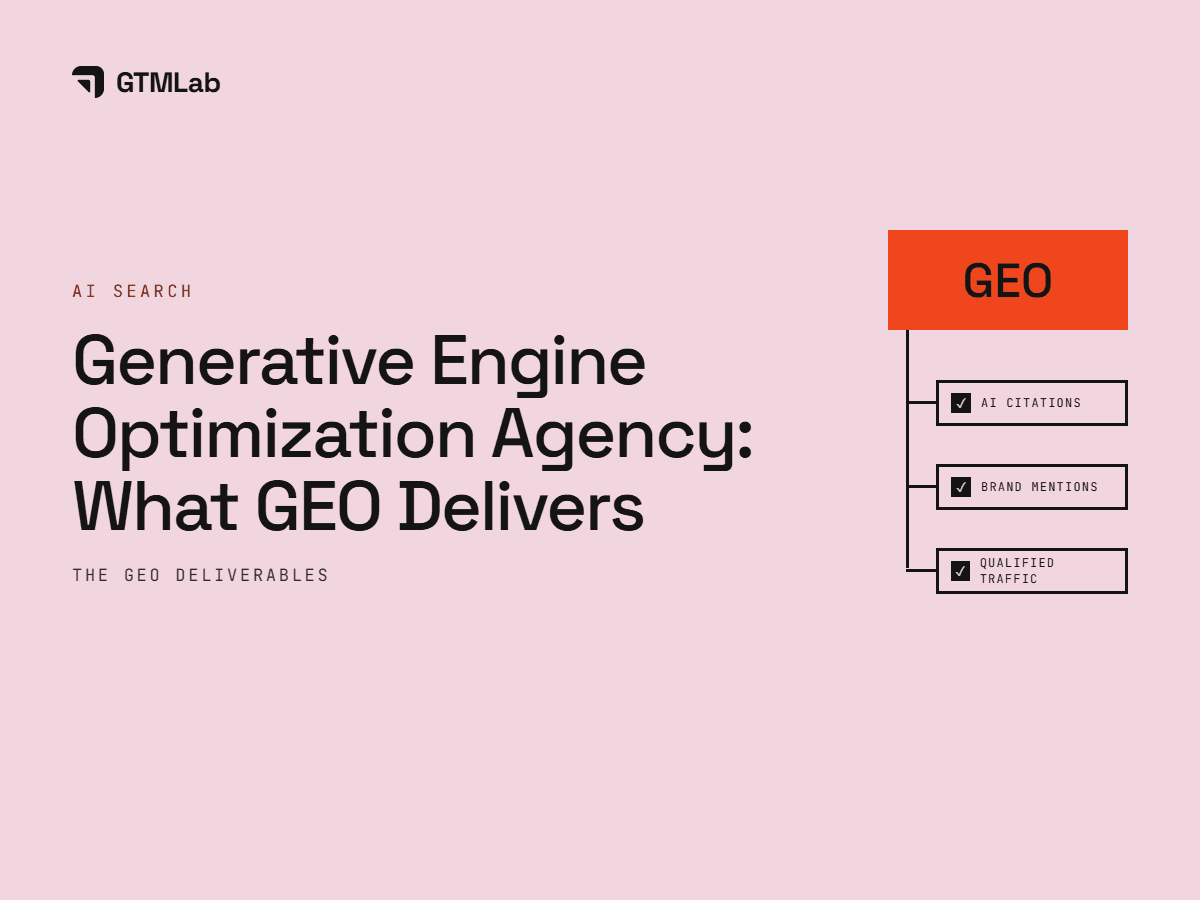
Short answer: A generative engine optimization agency increases how often AI engines such as ChatGPT, Perplexity, Gemini and Google's AI Overviews mention and cite your brand. A real GEO retainer delivers four things every month: tracked buyer prompts across engines, pages rewritten so AI can quote them, consistent facts about your business across the web, and new mentions on the sources those engines trust. If a proposal cannot name the prompts it will move, it is a content package, not GEO.
Where GEO comes from
The term comes from a 2023 research paper by Pranjal Aggarwal and colleagues at Princeton University and IIT Delhi, later presented at KDD 2024. They described generative engines as systems that read several sources and write one answer, and tested how content changes affect which sources get used. Their methods lifted a source's visibility in generated answers by up to 40%, and by up to 37% on Perplexity, a live engine.
Generative engine optimization services turn that finding into ongoing work: making your brand one of the sources an AI engine reads, trusts and repeats when a buyer asks who to choose.
What the research says moves AI citations
Two studies are worth knowing before you sign with any GEO optimization agency.
- On-page evidence. In the Princeton study, adding statistics, quotations from credible sources and citations were among the most effective changes. Keyword stuffing, the old SEO habit, did not help.
- Off-site mentions. Ahrefs analysed 75,000 brands and found branded web mentions correlated with brand visibility in Google's AI Overviews at 0.664, against 0.218 for backlinks. Brands in the top quarter for web mentions averaged 169 AI Overview mentions, more than ten times the 14 averaged by the next quarter down, while 26% of brands had none at all.
The practical reading: GEO is half quotable evidence on your own pages and half being talked about elsewhere. An agency that only rewrites content, or only builds links, covers half the problem.
What a GEO retainer should deliver each month
| Deliverable | What you should see |
|---|---|
| Prompt tracking | Your buyer prompts checked in each engine, with who is named and which sources are cited |
| Answer-ready pages | Key pages rewritten so the first lines answer the prompt, with sourced numbers, prices and named experts |
| Fact alignment | Name, services, prices, hours and locations identical on your site, Google profile, directories and social |
| Earned mentions | New mentions on the review sites, directories, forums, best-of lists and press the engines already cite |
| Technical access | AI crawlers allowed in robots.txt, structured data that matches the page, indexable URLs |
| Task log | Every action, its date and the prompt it is meant to move |
At task level, GEO work is small and specific. Three real examples from GTMLab's task logs: answering a Reddit thread on family villas with real prices, because Gemini quoted that thread for three tracked prompts; adding six services and Sunday hours to a Google Business Profile, because Google's AI answers pull hours from it; and adding FAQ structured data to a pricing page, so engines can quote prices word for word.
Fact alignment usually starts with listings. For businesses with physical locations, that work overlaps with local search and maps.
GEO agency vs SEO agency
| Metrics | SEO agency | GEO agency |
|---|---|---|
| Goal | Rank pages in search results | Get the brand named and cited inside AI answers |
| What gets tracked | Keywords and positions | Buyer prompts and mentions, per engine |
| Main levers | Technical health, content, backlinks | Quotable evidence, consistent facts, third-party mentions |
| Off-site focus | Links | Mentions, linked or not, on sources AI reads |
| Success report | Rankings and organic traffic | Prompt visibility, citations, AI referrals and pipeline |
The two overlap more than the table suggests. Google says a page must be indexed and eligible to show with a snippet before it can appear as a supporting link in AI Overviews or AI Mode, so technical SEO still decides whether you can be cited at all. A GEO SEO agency that runs both from one plan avoids two teams rewriting the same pages for different goals.
What the first 90 days should produce
- Days 1 to 30: a prompt set built from real sales conversations, a baseline of who each engine names today, and technical blockers removed.
- Days 31 to 60: priority pages rewritten, facts aligned across listings, first earned mentions live.
- Days 61 to 90: first movement on tracked prompts, a review of which tasks moved them, and the prompts to target next quarter.
New or corrected pages can be picked up within weeks once crawlers can read them. Consistent mentions across engines usually take a few months, because engines recommend what several sources agree on. AI visibility tracking makes that progress visible prompt by prompt instead of leaving it to occasional spot checks.
Red flags in a GEO proposal
- "Number one in ChatGPT" for any query. AI answers vary by wording, user and day. Nobody controls a single answer.
- Fixed bundles with no prompts attached. Twenty articles or fifty backlinks a month says nothing about which answers will change.
- llms.txt sold as the main lever. It is a proposed standard, and no major engine has said it decides which businesses get recommended.
- No baseline. Without a record of today's answers, any later "improvement" cannot be checked.
- Visibility scores with no business link. A score that never connects to traffic, leads or revenue is hard to justify at renewal.
- AI-written content at scale as the strategy. The Princeton results favoured statistics, quotes and sources. Mass-produced pages rarely contain any of them.
What generative engine optimization services cost
Most AI GEO agency pricing depends on how many prompts are tracked and how much work is done each month. GTMLab's plans run from $499 a month (40 prompts, 30 logged tasks) to $1,999 a month (150 prompts, 140 logged tasks), on a six-month term with a quarterly performance guarantee: a set number of prompts where you are named, or no fee. A one-off AI Visibility & Rivals Report costs $300. Every plan and package is on the pricing page.
How GTMLab works as a generative engine optimization agency
GTMLab runs GEO with senior operators and no fixed content quota. Each day the team checks what changed for your prompts across ChatGPT, Gemini, Perplexity, Google's AI Overviews, Claude and Copilot, picks the few tasks that drive most of the result, does them, and logs each one with the reason behind it. A logged task is about 30 minutes of focused specialist work.
The same team runs SEO, paid media and CRM, so AI referrals are tracked in GA4 and, on Growth and Scale plans, matched to deals through the CRM using the same attribution setup as paid campaigns. The search groundwork behind this approach is shown on Medifly, a medical travel platform GTMLab built and runs, where organic clicks grew about 4× in three months. The full method is in how to rank in ChatGPT and get named in AI answers.
Find out which prompts you are missing. In a complimentary 30-minute AI Visibility Briefing, GTMLab checks 10 of your buyer questions in ChatGPT and Google's AI answers in advance, then walks you through who is named instead of you and the first three moves to change it. Book your briefing or talk to the team.
FAQ
What does a generative engine optimization agency do?
It makes your brand more likely to be named and cited in AI answers. The work covers tracking buyer prompts, rewriting pages so AI can quote them, aligning facts across the web, earning mentions on trusted sources and keeping AI crawlers able to read your site.
Is GEO the same as AEO or AI SEO?
In practice, yes. GEO (generative engine optimization), AEO (answer engine optimization) and AI SEO describe the same goal: being included in AI-generated answers. Providers use whichever label their buyers search for.
Is a GEO marketing agency the same thing?
Not always. "Geo marketing" is also used for location-based marketing, such as geotargeted ads. In AI search, GEO means generative engine optimization, so check which one a provider means before you compare proposals.
How long before GEO shows results?
New or corrected pages can appear in answers within weeks once they are crawlable. Steady mentions across engines usually take a few months, because engines favour what several sources agree on.
Can a GEO agency guarantee results?
No one can guarantee a specific AI answer. An agency can guarantee measurable outcomes, such as being named on a set number of tracked prompts each quarter, and tie its fee to that.
Do I still need SEO if I invest in GEO?
Yes. Google only cites pages in AI Overviews and AI Mode that are indexed and eligible for a snippet, and other engines lean on pages search engines already trust. SEO keeps you eligible; GEO gets you chosen.


