Winning in AI Search · The GEO Series
- Chapter 1: Choosing your Money Prompts (you’re here)
- Chapter 2: Tracking who AI names, and how often (coming soon)
- Chapter 3: Working out why AI picks who it picks (coming soon)
- Chapter 4: The work that changes the answer (coming soon)
One evening in New York, my team and I needed somewhere to take a client for dinner. Nobody opened a review site. We all pulled out our phones.
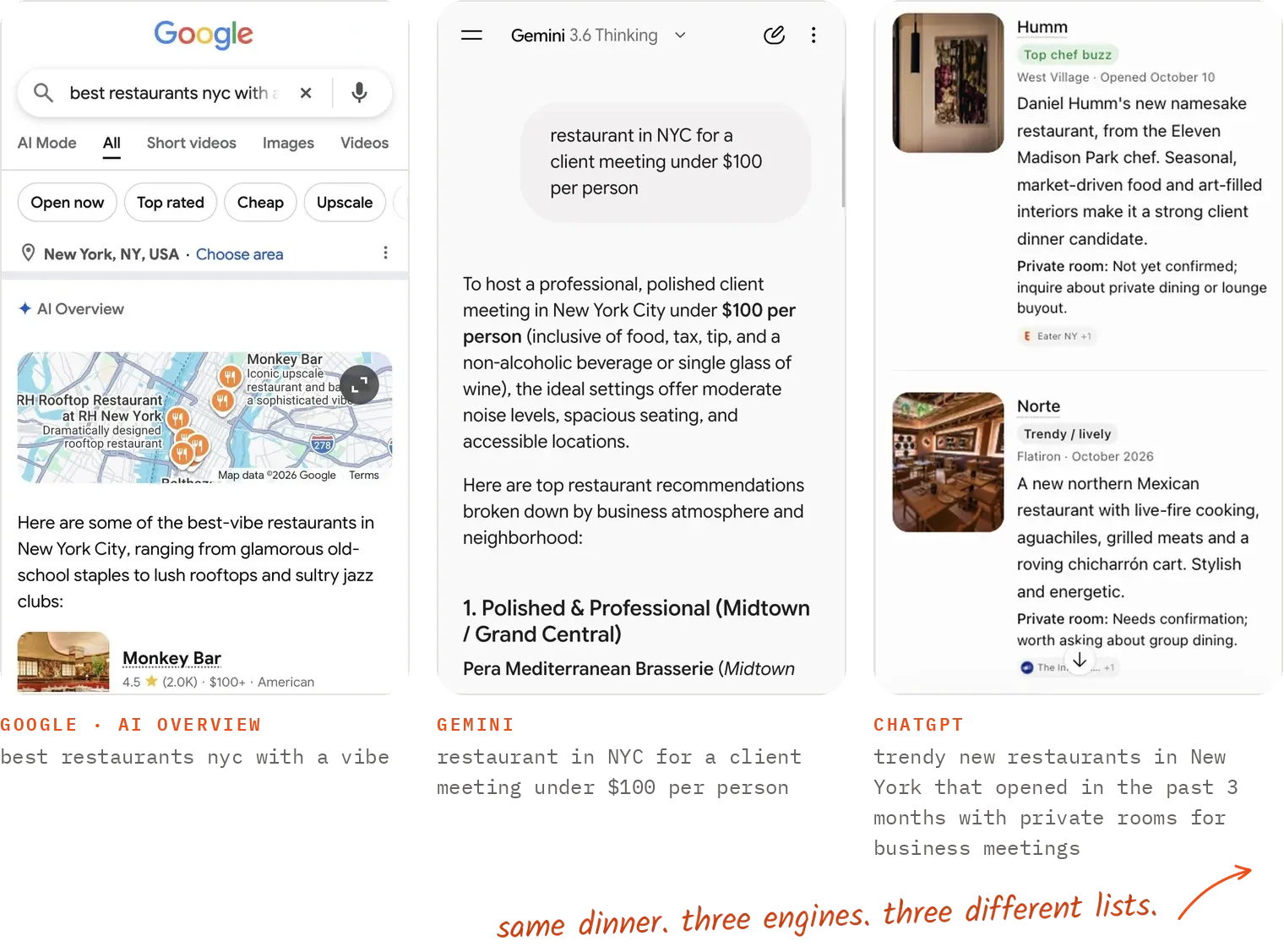
I typed what most people type into Google: best restaurants nyc with a vibe. Our head of operations skipped Google and asked Gemini: restaurant in NYC for a client meeting under $100 per person. The most junior person at the table typed a whole brief into ChatGPT: trendy new restaurants in New York that opened in the past 3 months with private rooms for business meetings.
Three people, three engines, three different shortlists. Each of us read the AI’s summary, tapped a name, opened Google Maps for more photos, and decided on the spot. None of us scrolled down to the blue links.
The decision happens before the click
That dinner is how buyers decide now, whether they’re choosing a restaurant, a SaaS tool or a supplier. It has a name: zero-click search. The question gets answered right on the results page or in the chat, and the decision is mostly made before anyone visits a website. By the time a buyer lands on your site, they’re usually confirming a choice, not making one.
Look closely at the Gemini answer. It didn’t just name restaurants. For its first pick, it quoted entrées at $25 to $36, pulled from the restaurant’s online menu. AI repeats what it can read. If your prices, your rooms and your reasons to be chosen aren’t written somewhere it reads, they can’t make it into the answer.
AI search is the next Meta
Very few businesses have worked this out yet. A decade ago, the brands that moved early on Facebook ads won customers while their competitors were still ignoring the channel. AI search is that moment again, with one difference: you don’t buy your place in the answer with Google Ads or Meta ads. You earn it.
That’s GEO, or generative engine optimisation: getting AI assistants to name you when buyers ask for what you sell, at the moment they’re deciding on a high-consideration purchase. It matters more every month, because people hand more of their decisions to AI. ChatGPT, Gemini and Google’s AI Overviews don’t give people ten blue links. They read a handful of sources, then write one answer with a few names in it. You’re either one of those names or you’re not.
So how do you win?
There’s a predictable way to get a business into those answers, and we run it for every client. First, what it isn’t: letting an AI publish hundreds of articles on your website.
Where we were wrong: we tried the AI-articles route. It failed. Engines don’t reward volume. They quote the page that answers the question best, from sources they already trust.
What works is people doing deliberate work against specific questions, every day, then checking whether the answer moved. Our formula has five steps, and it runs as a loop:
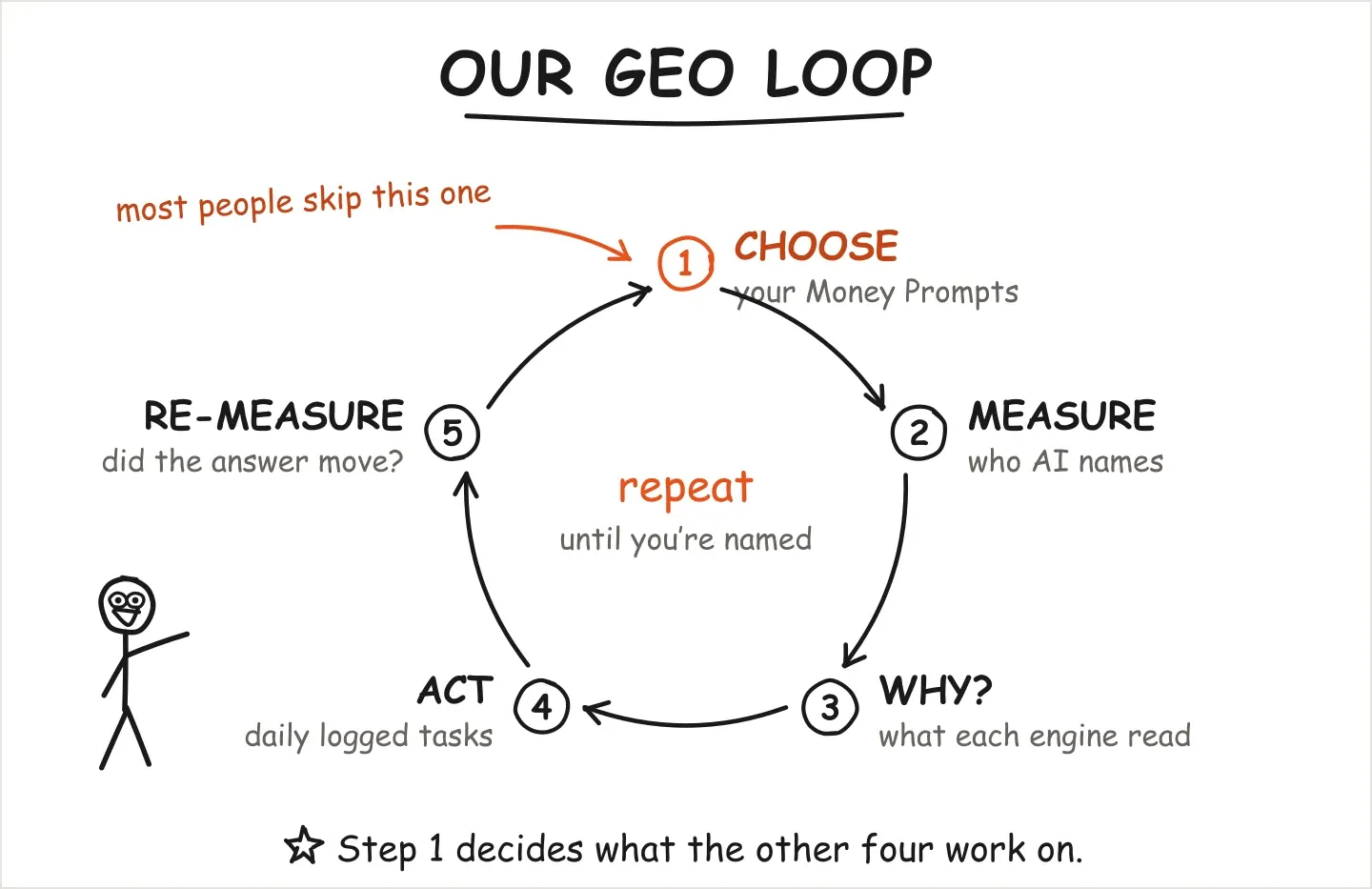
- Choose the right prompts. The questions your buyers actually type or ask, where AI answers with names, and where you can realistically win.
- Measure. Our AI tracking tool runs every prompt daily and records who AI names, how often, and in what order. Per engine, because ChatGPT, Gemini and AI Overviews rarely agree.
- Reverse-engineer why. For each prompt, which sources and pages did each engine read before it answered, and who did it name instead of you?
- Act. Daily logged tasks on whatever moves that prompt most: a page on your own site, an FAQ, a guide or PR mention on a site the engine already reads, a Reddit thread, a fix to your Google Maps listing.
- Re-measure. Did the answer change, on which engine, for which prompts? What worked shapes the next task. Prompts that turn out to be wrong get swapped.
Each step gets its own chapter in this series. This one is about step one, because everything else depends on it.
Step one: your Money Prompts
Choosing the right prompts is the first decision in GEO, and the most important one. Internally, we call them Money Prompts: the questions where your buyer’s decision gets made, and where showing up turns into revenue.
Every Money Prompt comes with its own path to winning, and you work that path out backwards from the prompt. To show up for best pilates studios in nyc, you need a page that makes the case for why you’re one of the best, in specifics AI can repeat: your instructors, your classes, what your clients say. To win steakhouses under $200 for business meetings, you need your menu on a page with every dish and price in plain text. A PDF menu gives the engine nothing to quote, so your prices never make it into the answer.
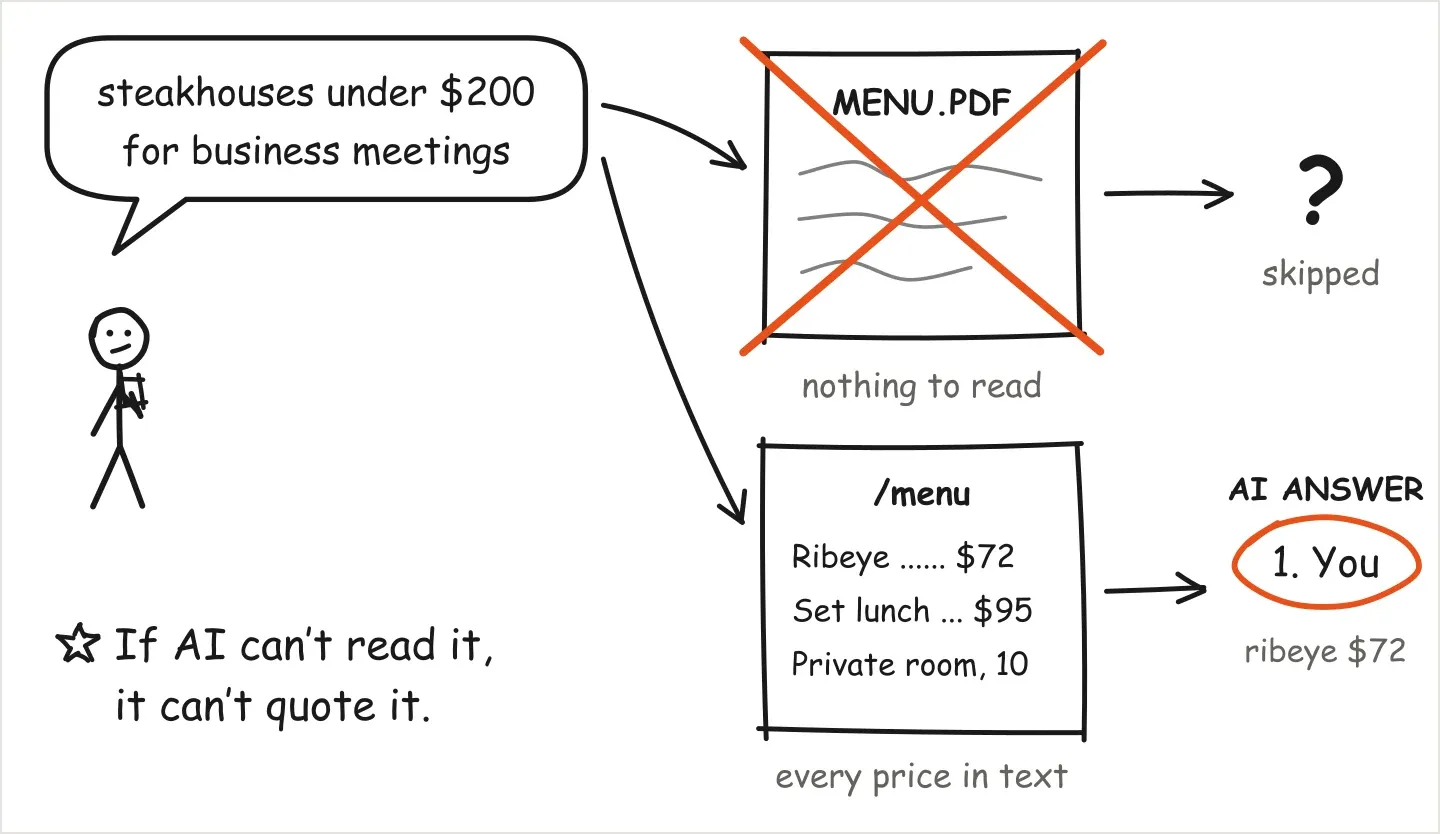
So this is a strategy game, not a content game. Every prompt you pick decides a page, a listing or a mention, and they all have to work together.
Every task in the loop is aimed at a prompt. The prompt list is the brief for everything that follows.
The prompt list does three jobs at once:
- It’s the scoreboard. Visibility, position and share of voice are all calculated on the prompts you track. Track the wrong ones and a good month looks bad, or a bad month looks good.
- It’s the work plan. Every page, FAQ, mention and listing fix is chosen because it moves a specific prompt. A vague list produces vague work.
- It’s the promise. When we put a guarantee on results, it’s counted on these prompts. So we only count the ones we believe we can win.
Prompt lists usually go wrong in the same few ways. They’re written from the inside: the owner’s favourite keywords, the brand name, or long scenarios no buyer would ever type. Here are the ten rules we use to avoid that, each one learned in a real client session. The first five are how to write a Money Prompt, and you can use them today. The last five are how we build and judge the whole set.
Rule 1 · Half short searches, half full questions
Buyers reach AI two ways. Some type a few words into Google and read the AI Overview at the top. Others open ChatGPT or Gemini and ask a full question, often with their situation in it. A good set covers both, so every set we build is half and half.
The short half: exact Google autocomplete
Two to six words, copied word for word from Google autocomplete. If Google doesn’t suggest a string, people aren’t typing it often enough to matter. When autocomplete and our word-count guide disagree, autocomplete wins. In Singapore, typing halal restaurant for suggests halal restaurant for team dinner, halal restaurant for big groups and halal restaurant for business lunch. That’s buyers telling you what they want, in their own word order.
| Google suggests | Monthly searches |
|---|---|
| kids | Hidden |
| a view | 70 |
| vegetarian options | Hidden |
| gluten free options | Hidden |
| vegan options | Hidden |
| private rooms | Hidden |
| outdoor seating | Hidden |
| teens | Hidden |
| a vibe | Hidden |
| family | Hidden |
“a vibe” is the one I typed. No number, still a real search. Source: Google autocomplete (US) and Google Ads search volume, both pulled 31 Oct 2026. “Hidden” means Google reports no figure, not zero searches.
Google suggests all ten, so people type all ten. Google’s keyword tool puts a number on one. If we picked prompts by volume alone, we’d miss nine real ways buyers ask. That’s why autocomplete decides the wording, and volume only helps us compare.
Autocomplete moves, so we re-check every string on the day tracking starts. On one hotel set we re-checked 36 strings a day after pulling them, and 35 still held.
The long half: the question a buyer asks AI
Seven to twelve words, written the way a real person asks an assistant. These carry the buyer’s situation, trigger or doubt: Do I qualify for R&D tax credits without an in-house lab? or Which industrial cleaning suppliers can service several factories across Java? We pull them from the client’s FAQ, their sales calls, and the fears buyers raise before they sign.
Autocomplete rarely reaches these lengths, so there’s usually no volume to quote. We note the volume of the parent search instead, and keep every other rule: one intent each, no years, no “near me”, the buyer’s language.
Why not just one half? A short-only list reads like a Google Ads keyword sheet and misses how people talk to AI. A long-only list is guesswork with no demand data behind it. Together they cover the person skimming an AI Overview and the person asking ChatGPT for advice.
Rule 2 · One prompt per intent
AI gives the same answer to rewordings. best halal restaurant singapore and top halal restaurants in singapore are one question to an engine, so tracking both doubles the count without adding information. It also inflates the score: win one and you appear to have won two.
We keep the wording buyers use most and drop the rest. The same applies across the two halves: a full question and a short search can’t share an intent. If the short search already covers team dinners, the full question should cover something else.
Rule 3 · No “near me”, no years
“Near me” has no fixed answer. AI answers it from wherever the person asking happens to be, and tracking runs from a country, not a street corner. There’s nothing stable to measure or win. So we anchor location to a place people actually type: a street, a landmark, a station, a mall, a hospital. Singapore’s autocomplete is full of them: halal restaurant near raffles place mrt, halal buffet raffles city.
Before accepting any location prompt, we check it’s where the client actually is. On one nightlife set, a suggested prompt named the city’s central district. The venue is in the south, so AI would have named a different set of bars, and we’d have been measuring someone else’s market.
Years go stale. A hotel search with the year in it stopped autocompleting within a day of us pulling it, and a prompt with this year in it is out of date halfway through any engagement. We use the plain form.
One qualifier is worth adding: the one that filters out the wrong answers. “4-star” keeps budget sister brands and budget chains out of a hotel answer. A district name keeps namesake hotels in other cities out. One word, chosen for what it removes.
Rule 4 · Choose prompts where AI answers with names
Some questions get a list of businesses. Others get an explanation. What is a dental implant? gets a paragraph about titanium posts. You might be cited as a source, but nobody’s being chosen. best dentist in bali for implants gets names, and that’s the answer a buyer acts on.
So most of a set sits where AI names businesses: best, recommend, price and cost, which and where. dental implants bali cost is a good example. The buyer is close to a decision, and clinics that publish clear prices give the engine something to quote.
A few learning questions earn a place too, where your page can become the source AI quotes. But we check every prompt’s real answer before keeping it. On one nightlife set, date ideas returned activities, not venues, and a premium champagne search returned shops selling the bottle. Both were dropped.
Rule 5 · Use your buyers’ words, not yours
Businesses describe themselves in their own vocabulary. Buyers don’t. In Indonesia, many patients search for permanent dentures when they mean implants. Hotel buyers ask for a meeting room, not a “conference room”. Value-seekers type cheap but good, not “value”. Words like “premium” and “venue” sound right in a brochure and almost never show up in a search box.
Sometimes the owner’s favourite keyword means something else entirely to the people typing it. One venue wanted to win best lounge in its city. The data showed that search is mostly people looking for airport lounges.
Language works the same way. In Indonesia, patients search for dentists and hotels in Bahasa, while big-city nightlife crowds search mostly in English. We write each prompt in the language the buyer uses, and we never translate an English list into another language.
The sharpest version of this rule: name your real buyers first, then keep only their questions. For one hotel group we went through more than 20,000 guest reviews and found three buyers: the civil servant on an official trip, the family from the surrounding suburbs, and the out-of-town guest in the city on business. That cut prompts that had search volume but would never be typed by those guests. Someone booking a 4-star room doesn’t search for the cheapest hotel near the station.
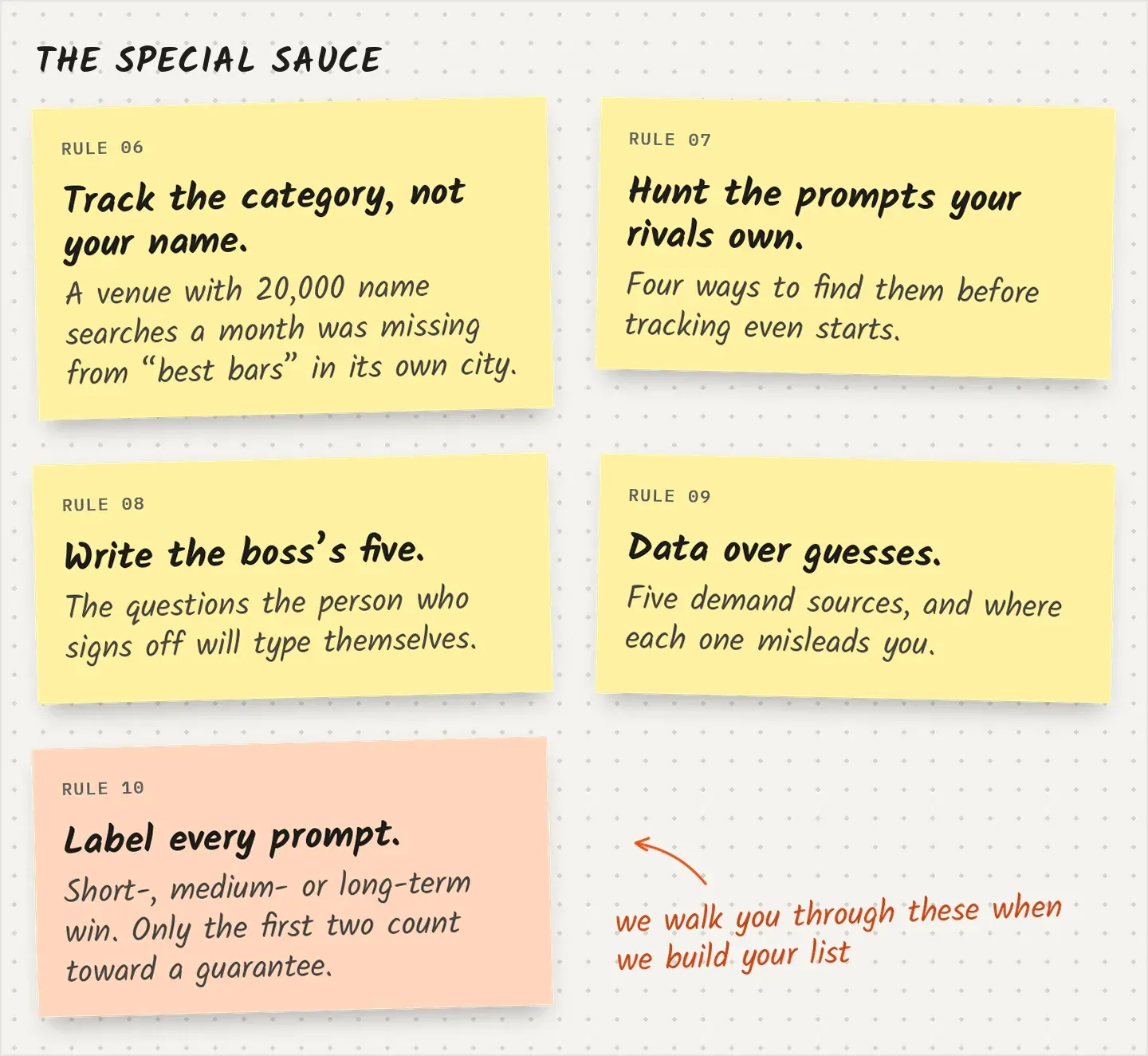
Rules 6 to 10 · The special sauce
Rules 1 to 5 tell you how to write a good prompt. Rules 6 to 10 decide which prompts make the cut, which ones a competitor owns, and which ones we’ll put a guarantee on. That’s where most of the judgment sits, so it’s the part we work through with each client, on their data.
Want us to build your set? Explore a partnership.
What a finished set looks like
For a single-service business, about 30 prompts. For businesses with several locations or segments, about 40. Each prompt has its half (short or full), its funnel stage, its win label and a line on why it’s in. Stages run from learning at the top, to comparing in the middle, to choosing a business at the bottom. Inside each stage, short-term wins come first.
Here’s what a few rows might look like for a halal restaurant group in Singapore. The short searches are live Google Singapore autocomplete strings, pulled for this post. The full questions are written the way a buyer would ask.
| Prompt | Half | Stage | Win | Why it’s in |
|---|---|---|---|---|
| halal private dining room singapore | Short | Choosing | Short-term | If your private-room page lists capacity, menus and prices, few rivals answer it as clearly. |
| halal restaurant singapore for team dinner | Short | Choosing | Medium-term | Corporate groups book big and come back. Needs a group-dining page AI can quote. |
| Which halal restaurants in Singapore have a menu kids will actually eat? | Full | Comparing | Medium-term | Families decide together. A kids’ menu page gives AI something specific to quote. |
| best halal hotel buffet | Short | Comparing | Long-term | Likely owned by hotels and food listicles today. In the set for the decision-maker, not the guarantee. |
| Are halal-certified restaurants different from Muslim-owned ones? | Full | Learning | Medium-term | A real doubt before booking. A clear certification page can make you the source AI quotes. |
If we’ve sent you a list
If you’re reading this after a first call with us, you’ll have a suggested list of Money Prompts: about half short searches and half full questions, each with a stage, a win label and a line on why it’s in. Three things make it better:
- Send us the questions your customers actually ask you. On WhatsApp, at the front desk, on sales calls. Their exact words are worth more than our best guess.
- Tell us who you lose to, and on what. That’s where the competitor-owned prompts come from.
- Flag anything that’s wrong for your business. A service you don’t offer, an area you don’t serve, a label you’d rather not be known by.
We’ll merge your list with ours, keep your phrasing wherever it’s a real question, fold rewordings into one, and send back the final set with the reason each prompt is in. Then tracking starts, and within a few days you’ll see who AI names for your questions today, on each engine. That’s the first measurement in the loop, and the baseline everything after it is measured against.
The checklist
- Half the set is short searches, copied word for word from Google autocomplete.
- Half is full questions of 7 to 12 words, in the buyer’s own situation.
- One prompt per intent. Rewordings are cut.
- No “near me”, no years. Locations are places people actually type.
- AI answers most prompts with names: best, recommend, price, which, where.
- Every prompt uses the buyer’s words and the buyer’s language.
- Then rules 6 to 10: the category over your name, the prompts rivals own, the boss’s five, data over guesses, and a win label on every prompt.
Choosing Money Prompts is step one, and it’s the step that keeps the other four honest. Measure the wrong questions and you’re tracking noise. Act on the wrong questions and you’re building pages nobody asked for. Get the list right and every task in the loop has a target, and every month has a number that means something.
In the next chapters, I’ll cover the rest of the loop: how we track Money Prompts across engines, how we work out why AI picks who it picks, and the work that changes the answer.


