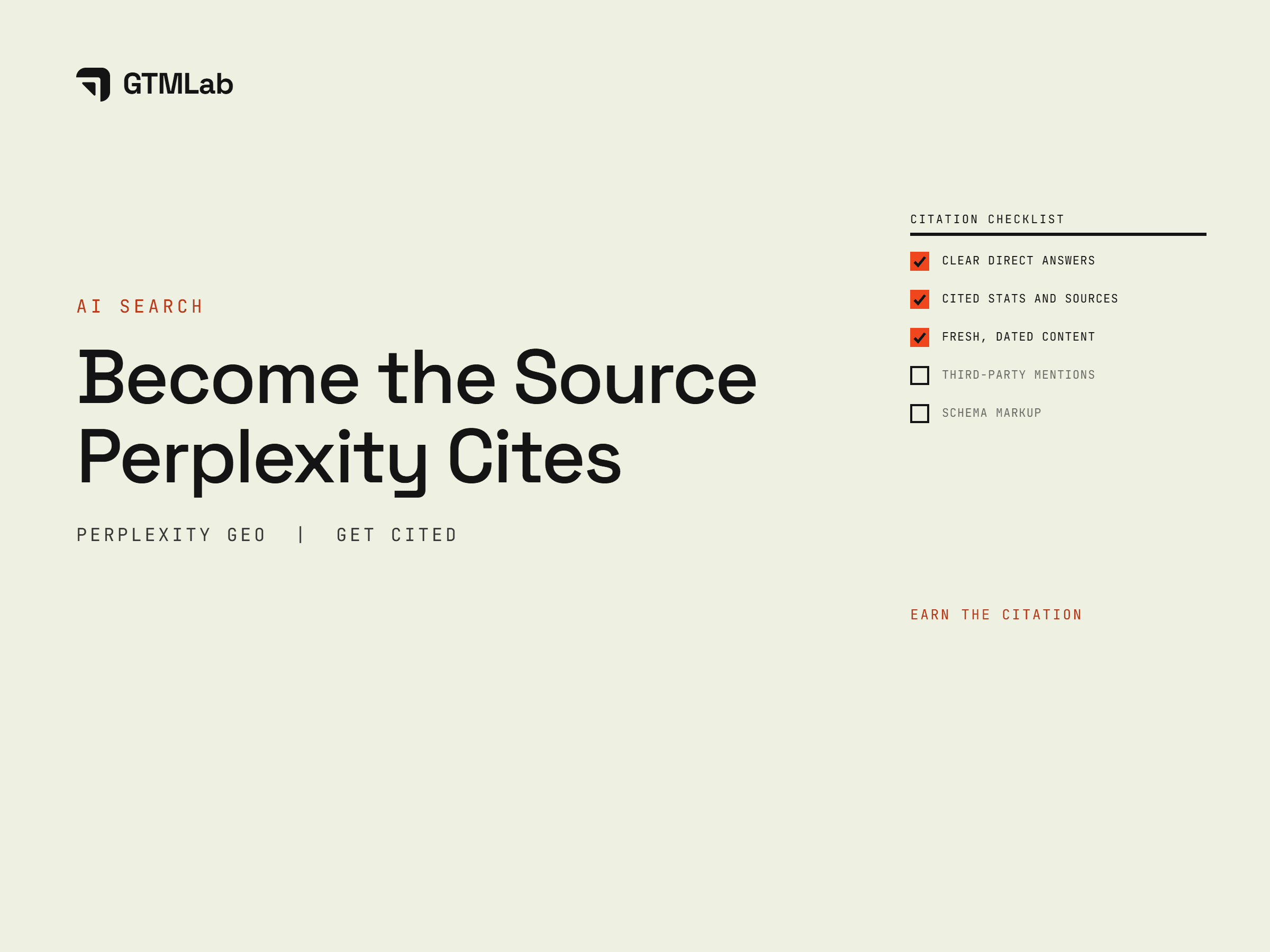
To improve your chances of being cited by Perplexity, make your pages accessible, answer a specific buyer question, and support the answer with verifiable evidence. To earn a brand recommendation, also explain who your business serves, where it operates, and why it fits the buyer’s requirements. Track citations and recommendations separately.
A useful guide can earn a source link without putting its publisher on the buyer’s shortlist. A brand can also appear in an answer supported by someone else’s website.
That distinction should shape your Perplexity SEO work. The goal is to give the answer a reliable source and the buyer a clear reason to consider your business.
What does “ranking in Perplexity” mean?
For measurement, treat ranking in Perplexity as visibility within a particular answer. Record whether your brand is named, recommended, or cited for a defined question, location, and search mode.
Perplexity describes its process as searching the web, synthesizing relevant information, and linking to original sources through numbered citations. A citation therefore tells you which source supported an answer. It does not, by itself, tell you which business the answer recommends.
| Outcome | What to record | What it tells you |
|---|---|---|
| Brand mention | Your business is named in the answer. | The brand is visible in that response. |
| Recommendation | The answer presents your business as a suitable option. | The brand is considered relevant to that buyer’s request. |
| Website citation | An answer citation links to your domain | Your website supplied supporting information. |
| Retrieved only | A tracking tool shows your page was retrieved, but it has no answer citation. | The page was encountered; a citation was not observed. |
For example, a hotel’s guide to local attractions could be cited in an itinerary that recommends a different hotel. Record the citation. Do not count it as a booking recommendation.
1. Choose the buyer question before choosing the page
Start with the decision you want to influence. “What is Perplexity SEO?” and “Which agency can improve our Perplexity visibility?” require different evidence.
Use real sales questions to build a small prompt set. For example:
- Agency buyer: “Which GEO agencies in Singapore help B2B companies get cited in Perplexity?”
- Hotel guest: “Which hotels in central Jakarta suit a family staying for three nights?”
- Software buyer: “Which CRM tools support WhatsApp lead follow-up for a small sales team?”
These are illustrative prompts. Replace the location, requirements, and wording with what your customers actually ask.
Keep unbranded discovery separate from questions that already name your business. Appearing in “Is [brand] suitable for us?” does not establish that buyers will discover you through “Which provider should we choose?”
Assign each question to the page best equipped to answer it: a service page, product page, comparison, pricing guide, or documented case study.
2. Check whether Perplexity can access the source page
Confirm access before rewriting the content. A page that opens in your browser can still face crawler restrictions or a security challenge.
Perplexity’s crawler documentation identifies PerplexityBot as its search crawler and recommends allowing it through robots.txt and the published IP ranges. It distinguishes this from Perplexity-User, which supports user-requested page visits.
Ask your developer to check:
- The intended public URL returns the article or service content successfully.
- Robots.txt permits the intended search crawler.
- The firewall is not replacing the page with a challenge or access-denied response.
- The main answer, evidence, and links are available as readable page text.
- The URL is linked from relevant pages on your site.
Perplexity’s documented firewall approach combines user-agent checks with its current published IP ranges. Use verified access rules rather than allowing every request that claims to be a bot.
Passing these checks makes access possible. It does not guarantee selection as a source.
3. Give each page a short, complete answer
Put the answer immediately below the relevant heading, then add the evidence needed to trust it. A reader should understand the paragraph without reading the entire article.
Compare these two openings for a hypothetical service page:
Vague: “We help ambitious businesses unlock the future of intelligent growth.”
Specific: “Our team helps B2B companies improve visibility in AI search through buyer-prompt research, website improvements, and citation tracking. The work covers service pages, comparison content, and the sources buyers encounter before contacting sales.”
The second version states the audience, service, and scope. Add actual markets, deliverables, and evidence where they apply. Do not invent capabilities to match a prompt.
For a pricing question, explain the price and exclusions. For a comparison, state the criteria. For a how-to question, give the steps and the conditions under which they work.
This is an editorial method for making answers usable. It is not a published Perplexity ranking formula.
4. Add evidence another person can verify
Make your strongest claim traceable to a source, method, or observed result. “We improved AI visibility” leaves too much unanswered.
A useful AI visibility case study identifies the prompt set, engine, market, language, dates, sample size, and measured outcome. Link the supporting response captures or source records where you have permission to publish them.
For other page types, evidence might be a product specification, a transparent price breakdown, an original calculation, or a customer case study with a defined timeframe.
Place the evidence beside the claim. If a result covers one market or one engine, state that boundary in the same paragraph.
Paid-media returns and organic traffic growth can demonstrate experience in those disciplines. They do not establish that a business gained Perplexity or ChatGPT citations.
5. Make the business behind the answer easy to evaluate
A recommendation needs enough information to assess fit. A helpful article may answer the research question while leaving the provider’s capabilities unclear.
Review your service and company pages for five facts:
- What you actually deliver.
- Who the service is suitable for.
- Which markets you serve.
- What proof supports the offer.
- How a buyer can evaluate scope, price, and next steps.
Keep those facts accurate across your website and relevant external profiles. When a directory has an old location or service description, correct it at the source.
Inspect the sources cited for your target questions. If legitimate industry directories, customer reviews, or specialist publications appear repeatedly, assess whether your business has a useful, accurate contribution there.
Earn coverage through relevant expertise and evidence. Do not manufacture reviews or present paid placement as independent endorsement.
Why does Perplexity cite your article but recommend someone else?
The article may support the answer without establishing that your business is the best fit. Diagnose the cited passage and the recommendation separately.
Open the citation and identify the exact claim it supports. Then read what the answer says about the recommended businesses.
If your article supplies general advice, strengthen the connection to a relevant service page. If the buyer asks for a particular location or capability, check whether your public information confirms that fit. If your business does not meet the requirement, choose a more relevant prompt.
Do not add your brand repeatedly to force a recommendation. Improve the missing information that a buyer would need to make the same decision.
How to measure Perplexity citations without inflating progress
Use the same prompt set and comparable settings, then report each outcome with its sample size. Keep the exact question, date, language, market, mode, full answer, and cited URLs.
For a proposed weekly review, collect repeated observations across the week. Keep new prompts separate until they have comparable coverage. Record missing observations as “not observed.”
Website citation rate = observed answers citing your domain ÷ all observed answers in the same prompt and engine group.
For illustration, if 6 of 20 observed answers cite your website, the citation rate is 30%. If only 2 recommend your business, the recommendation rate is 10%. Those are separate outcomes, and the numbers here are hypothetical.
Review individual prompts before combining results. A gain on a branded comparison should not hide a lack of visibility on unbranded buyer questions.
Use analytics and lead records to assess referral visits and enquiries separately. A citation count is not a traffic or revenue figure. Before-and-after changes are descriptive unless your evaluation supports a causal conclusion.
Will these improvements also help ChatGPT cite your website?
Clear answers and verifiable evidence are useful foundations for both platforms, but results must be tested separately. A Perplexity citation does not establish that ChatGPT will cite the same page.
There is also a separate access check. OpenAI documents OAI-SearchBot as the crawler used for ChatGPT search visibility. GPTBot serves a different purpose related to model training; its setting is independent.
For ChatGPT, keep a separate test set using the same buyer questions. Examples include: “How can I get my business cited by Perplexity?” and “Why does Perplexity cite my website but not recommend my brand?” Save each response and verify the exact URL cited. Track whether the answer names your business as well as citing your website.
Broader ChatGPT discovery work belongs in a separate prompt set. See our guide to getting named in ChatGPT answers.
What should you fix first?
Choose one commercially relevant question and improve the page that should answer it.
- Capture the current answer and its cited sources.
- Resolve access problems on the target page.
- Write a direct answer with specific supporting facts.
- Add verifiable evidence and a relevant service link.
- Repeat the measurement with the same prompt and settings.
If you are already cited but rarely recommended, focus on buyer fit and business evidence. If you are absent, investigate access, relevance, and the sources selected in the observed answers.
Find the gap in your AI visibility
At GTMLab, our AI Search & SEO services connect buyer questions, website improvements, and visibility measurement. Start with the AI Visibility Check to see where your business appears and which competitors are named.
Frequently asked questions
What is the difference between Perplexity SEO and Google SEO?
Perplexity SEO focuses on appearing in Perplexity answers and their source citations. Google SEO focuses on visibility in Google Search. Both benefit from accessible, relevant pages, but you need separate measurements: a Google ranking does not establish a Perplexity citation.
Can Perplexity recommend my business without citing my website?
Yes. An answer can recommend your business using a directory, review, or another publisher as its source. Record the brand recommendation and the external source URL. Count an owned-site citation only when the answer cites your domain.
Does adding an FAQ guarantee an AI citation?
No. An FAQ is useful when it answers real questions with specific, supported information. Each answer should make sense on its own. Its presence, length, or formatting does not establish that an AI engine will select your page.
Do I need special schema for Google AI Overviews?
No. Google states that no special schema is required for AI Overviews or AI Mode. A supporting page must be indexed and eligible to appear in Search with a snippet. Eligibility does not guarantee inclusion.
How long does it take to get cited by Perplexity or ChatGPT?
There is no reliable fixed deadline for a specific citation. Record when you change the page, check access, and compare repeated observations using consistent prompts and settings. A new citation is an observation to investigate, not proof that one edit caused it.
Can GTMLab help improve visibility across AI search engines?
GTMLab offers AI Search & SEO services covering buyer-prompt research, website improvements, and visibility measurement. Evaluate ChatGPT, Perplexity, Gemini, and Google AI search separately. The useful outcome is evidence of where your brand is mentioned, recommended, or cited, followed by prioritized work on the gaps.


