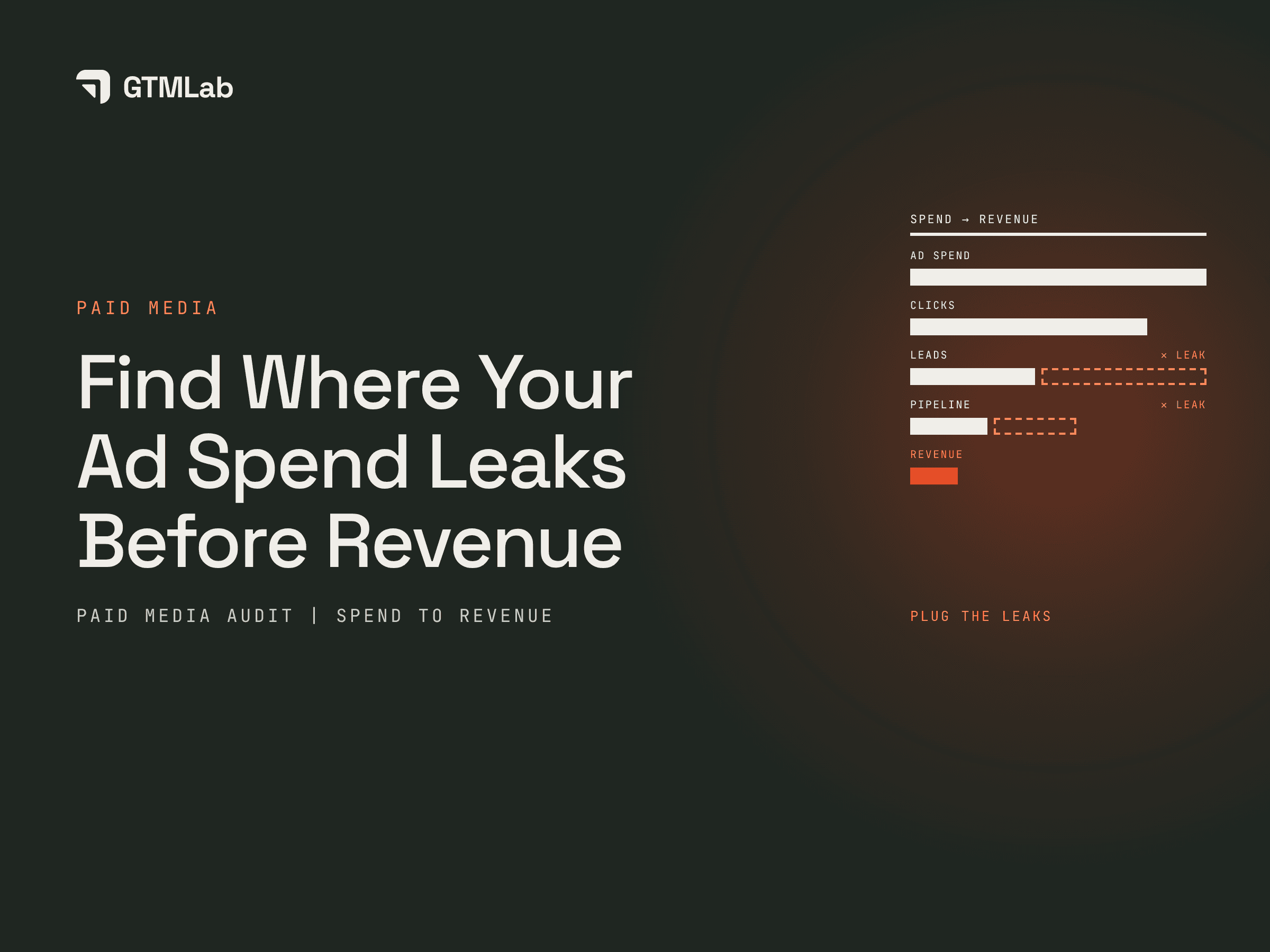
A paid media audit reviews your advertising, conversion tracking and customer journey to identify where budget is being wasted and what is preventing enquiries from becoming customers.
For a lead generation business, it should connect campaign performance to qualified leads, sales opportunities and closed revenue.
Start with a business question: which campaigns bring customers at a cost you can sustain? If your reporting ends at clicks or form submissions, the audit needs to investigate what happens next before recommending more spend.
What should a paid media audit cover?
A useful audit follows the journey from the ad impression to the sale. It examines how media buying, creative, landing pages and sales handling work together, while identifying who owns each problem.
Use this paid media audit checklist to define the scope:
| Area | What to check | Decision it should support |
|---|---|---|
| Business economics | Customer value, margins, sales cycle and acquisition costs | What can you afford to spend to acquire a customer? |
| Measurement | Conversion definitions, event accuracy and CRM records | Can you trust the signals used to optimise campaigns? |
| Media allocation | Channel roles, targeting, search intent and budget distribution | Where should budget be protected, reduced or tested? |
| Creative and offer | Claims, hooks, proof, incentives and buyer readiness | Does the message attract the customers you want? |
| Landing experience | Message consistency, mobile usability and form completion | Can an interested visitor take the next step? |
| Sales handoff | Routing, response times, qualification and follow-up | Where do valid enquiries stop progressing? |
An account settings review can form part of the work. A full-funnel audit also checks whether the campaign is solving the right commercial problem.
How to conduct a paid media audit
1. Define success before comparing campaigns
Agree on what counts as a valid lead, a qualified lead and a customer. Use definitions that marketing and sales can apply consistently. A contactable enquiry is not automatically a sales opportunity.
Collect ad spend, enquiry records, qualification outcomes, sales stages and closed revenue for the same acquisition cohorts.
Allow enough time for those leads to progress through your normal sales cycle. Comparing this week's spend with sales from leads generated months ago can give a misleading picture.
Keep the cost definitions explicit. Ad spend divided by new customers gives you an advertising-only acquisition cost. A fully loaded customer acquisition cost also includes the relevant sales and marketing expenses.
Illustrative example, not GTMLab client results: two campaigns each spend $3,000. Campaign A produces 150 leads and three customers. Campaign B produces 60 leads and six customers. Campaign A has the lower cost per lead, at $20 versus $50, but Campaign B has the lower advertising cost per customer, at $500 versus $1,000.
Before reallocating budget, check whether customer value, margins and the time available to close each cohort are comparable.
2. Verify what the advertising platforms count as a conversion
List each conversion event and test what triggers it. A WhatsApp button click, a completed form, a qualified enquiry and a paid booking represent different stages of the journey.
Check for events that fire before an action is completed, duplicate submissions, missing source information and sales outcomes that never reach your reporting.
In Google Ads, primary conversion actions can guide bidding when their standard goal is selected for the campaign.
Secondary actions are generally observation-only, although actions included in a custom goal can be used for bidding regardless of that setting.
Review the campaign's actual goals rather than relying only on an event's label. Google's conversion action guidance explains this distinction.
Choose an optimisation event that balances business relevance with sufficient, timely and reliable data. Moving directly to closed sales is not automatically appropriate when sales are infrequent or take months to complete.
3. Review the role of each channel and audience
Separate campaigns that capture existing demand from those introducing your business to new buyers. Brand searches and retargeting may convert well partly because those audiences already know you.
For search campaigns, inspect the queries attracting spend and whether they match your service, geography and buyer intent. For paid social, examine the audience, exclusions, offer and subsequent lead quality together.
Then look at where budget is concentrated. Are you repeatedly reaching a small warm audience while new customer acquisition stalls? Are different campaigns competing for the same enquiries? Is an apparently expensive campaign producing more valuable opportunities?
Use attribution reports to understand the interactions that precede a conversion, but avoid treating attributed revenue as proof of incremental revenue. Attribution assigns credit; an incrementality test asks what would have happened without the advertising.
Google's attribution reporting documentation also explains how conversion paths and time-to-conversion reports can inform this review.
4. Audit creative and the offer together
Review the promise each ad makes and the type of person likely to respond. A broad giveaway may attract attention without attracting people who need your paid service.
Compare creative by message, offer and format. Use click-through rate to identify patterns, then check whether those patterns continue through qualification and sales. A high-click ad can still produce poor-fit enquiries.
Where buyers need time to evaluate the purchase, inspect the sequence between offers. Someone requesting a guide may need a relevant follow-up before a sales consultation. The next step should reflect what they requested and what they now need to decide.
Turn findings into specific tests. “Explain the intended customer and starting commitment before the form” is testable. “Improve the creative” is not a usable brief.
5. Follow the landing page journey on a real device
Open the ad destination on mobile and complete the intended action. Check whether the page delivers the same offer, explains who it is for and makes the next step clear.
Inspect form errors, unnecessary fields, unclear pricing expectations and messages that appear after submission. If the destination is WhatsApp, review the opening conversation and whether the team has enough context to respond usefully.
Separate persuasion problems from technical failures. A broken form needs a fix. A functioning page with weak qualification may need a different promise, proof or question. Those are different interventions and should be measured separately.
6. Trace enquiries through the sales handoff
Sample enquiries from campaigns with different performance patterns. Include won, lost, unqualified and unanswered leads so the review does not depend only on successful examples.
Check whether each enquiry reached the right person, received a response and moved into a recorded sales stage. Review rejection reasons with sales: “wrong service,” “outside delivery area” and “not ready yet” require different responses.
If valid enquiries repeatedly go unanswered, changing the targeting may leave the underlying problem untouched. If prospects consistently expect something the business does not offer, the ad or landing page may need to qualify expectations earlier.
Record unknown outcomes as unknown. A missing CRM status is a measurement gap, not evidence that a campaign produced no customers.
What should the audit deliver?
A paid media audit should produce a prioritised action plan with evidence, an owner and a way to evaluate each change.
For each finding, document:
- Evidence: the records, events or campaign patterns behind the finding.
- Business impact: the decision or stage of the funnel affected.
- Action and owner: what changes, and who implements it.
- Validation: how you will confirm the fix worked.
- Dependency: what must happen first, such as repairing tracking before comparing campaign returns.
Address broken measurement and failed customer journeys early. Then test improvements to acquisition quality and conversion. Expand spend when the evidence supports it and the business can handle the resulting demand.
Keep confirmed faults separate from hypotheses. A duplicate conversion event can be reproduced. The belief that a new offer will improve lead quality needs a controlled test and enough time to observe downstream outcomes.
How to choose a partner for a paid media audit
Ask who will inspect the ad accounts, who will review the CRM and who will own changes outside the advertising platform. Request an example of how a finding becomes an implementation task.
A useful partner should explain the limitations of the available data and show how recommendations connect to your sales process. Be cautious about proposals that prescribe higher spend before investigating conversion quality.
If the audit exposes a wider delivery gap, our guide to performance marketing companies provides a starting point for comparing partners and their operating models.
Turn the findings into an acquisition plan
The next step is to assign the work across paid media, creative, landing pages and sales operations. An audit only creates value when its findings lead to changes that can be checked against business outcomes.
GTMLab's full-funnel performance marketing connects paid media with creative, conversion journeys and CRM measurement. If your campaigns generate enquiries but you cannot see which ones become customers, discuss that gap with our team and explore the scope of an audit.
Frequently asked questions
Do campaigns need to stop during a paid media audit?
Usually, the review can happen while campaigns remain live. Keep a record of changes made during the audit so results remain interpretable. A verified issue such as a broken destination or incorrect offer may justify an immediate intervention.
Can you audit paid media without a CRM?
Yes, but the conclusions about lead quality and revenue will be limited. Start with a structured lead register containing the source, enquiry date, qualification status and outcome. Use only the customer information needed for the review, with appropriate access controls.
How much historical data does an audit need?
Use a period long enough to cover your usual sales cycle and a meaningful number of outcomes. Low-volume or seasonal businesses may need a longer view. Keep major changes in pricing, offers or tracking visible rather than pooling incompatible periods.
Does a paid media audit include implementation?
Only if it is included in the agreed scope. Confirm whether the deliverable is a diagnosis, a prioritised plan or hands-on fixes. Also agree who checks the results after changes go live.


