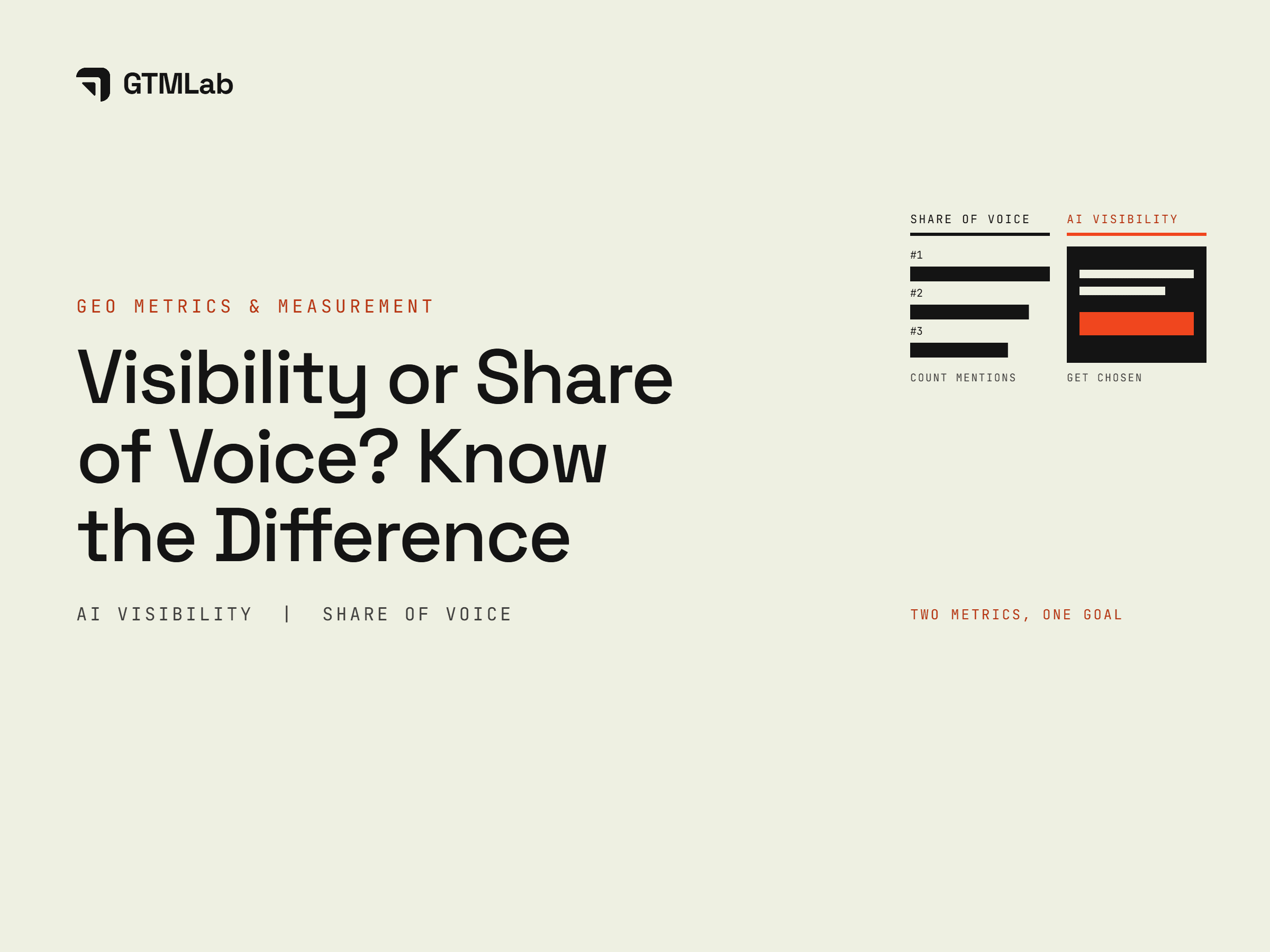
At a glance, AI visibility tells you how often your brand appears in the AI answers you track. On the other hand, AI share of voice compares your brand’s presence with the other brands included in the same analysis. These two percentages answer different questions, so understanding both helps you interpret your position more clearly.
To use them well, you need to know what each metric counts, which prompts were tested and which competitors were included. Those details give the numbers meaning and help you decide what to investigate next.
What is AI Visibility
AI visibility is a tool that describes how your business appears in AI-generated answers. It helps you understand whether the questions you review lead to mentions of your brand, how the answers describe it and whether they present it as a relevant option.
That presence can take several forms. Your business might appear in a shortlist, receive a recommendation for a particular need or have one of its pages cited as a source. Each tells you something different about how your business is represented.
When assessing visibility, consider the accuracy and relevance of the answer. Being named is more useful when the surrounding explanation reflects what you offer and who you can help.
AI Share of Voice Explained
AI share of voice gives your visibility a competitive context. It looks at your brand’s share of the brand mentions within the AI answers you review.
Your business may appear regularly while other brands are mentioned more often across the same questions. This comparison helps you see where your brand has a stronger presence and where competitors receive more coverage.
The most useful comparisons focus on relevant questions and businesses serving similar needs. This makes share of voice easier to interpret within your wider GEO reporting and helps you identify topics that deserve further attention.
The Role of AI Metrics in GEO
AI metrics help you assess whether your business is appearing for the topics and needs it serves. In GEO reporting, they provide a baseline and a way to review changes over time.
Visibility and share of voice become more useful when you can trace them back to particular prompts and saved answers. A report can then show which topics consistently include your business, where competitors appear more often and which areas deserve closer attention.
Read those figures alongside the quality of the answers. A brand mention, a suitable recommendation and a citation to your website are separate observations. Checking each helps you understand how your business is represented.
Website visits, enquiries and sales need their own evidence. Keep those outcomes alongside your AI metrics so the report shows both your presence in the tested answers and the identifiable activity that follows.
The Factors Behind Your Results
The prompts you track shape what your scores represent. Begin by choosing prompts that reflect your customers’ decisions, with coverage of the services, locations and requirements relevant to your business.
Several other choices affect the comparison:
- Competitor selection: Adding or removing brands changes the denominator of a share-of-voice calculation. Record those changes when comparing periods.
- Platform coverage: Report platforms separately before combining them. A combined score depends on how many answers you collect from each platform and how you weigh them.
- Testing conditions: Preserve prompt wording and record the language, location, model or mode, conversation setup and relevant personalization settings.
- Counting rules: Keep brand matching, repeated-mention treatment and any weighting consistent. Show the number of captured answers behind each percentage.
Normal answer variation also matters. Understanding why ChatGPT can give different answers helps you interpret changes between checks. Retain the underlying responses and review patterns across repeated tests before drawing conclusions from a score change.
When you expand the prompt set, identify the new coverage in your report. Keeping a stable core makes it easier to compare like-for-like results over time.
Using the Findings to Improve Content
Start with the topics where your business has relevant expertise but appears inconsistently or is described inaccurately. Review the saved answers and open the cited pages to understand what information supports them.
Compare those sources with your own content. Check whether your pages clearly explain the services, suitability, limitations and evidence a reader needs. Review public listings and other cited sources when the information about your business is incomplete or outdated.
When these gaps involve both your website and other sources, GTMLab can help prioritise and carry out the AI search optimization work. The team will review how your business is represented, improve the relevant information and track changes across the questions your customers ask.
After publishing, repeat the same tests and inspect the answers alongside the scores. Record changes in mentions, recommendations and factual accuracy separately. This gives your next content decision a clearer basis, while recognising that a score change alone cannot establish what caused it.
Frequently Asked Questions
Is AI share of voice the same as market share?
No. AI share of voice describes your relative presence within a defined analysis of AI answers. Market share measures a business’s proportion of a market, usually through sales or revenue. A share-of-voice percentage does not establish how much of the market your business serves.
Should branded prompts be included?
They can be useful, but report them separately from unbranded discovery prompts. Questions naming your business help assess how AI describes it. Questions asking for suitable providers help assess whether your business is introduced without the user supplying its name.
How should brand abbreviations and product names be counted?
Define the names and aliases that belong to each tracked brand before calculating results. Check ambiguous matches manually and decide how parent companies, sub-brands and products should be grouped. Apply the same rules across reporting periods.
What does a 0% score mean?
For mention-based visibility, it means your brand was not detected in the captured answers under the chosen matching rules. Check the saved responses and brand aliases before interpreting the result. If no included brands were mentioned at all, share of voice has a zero denominator and should be reported as unavailable.


