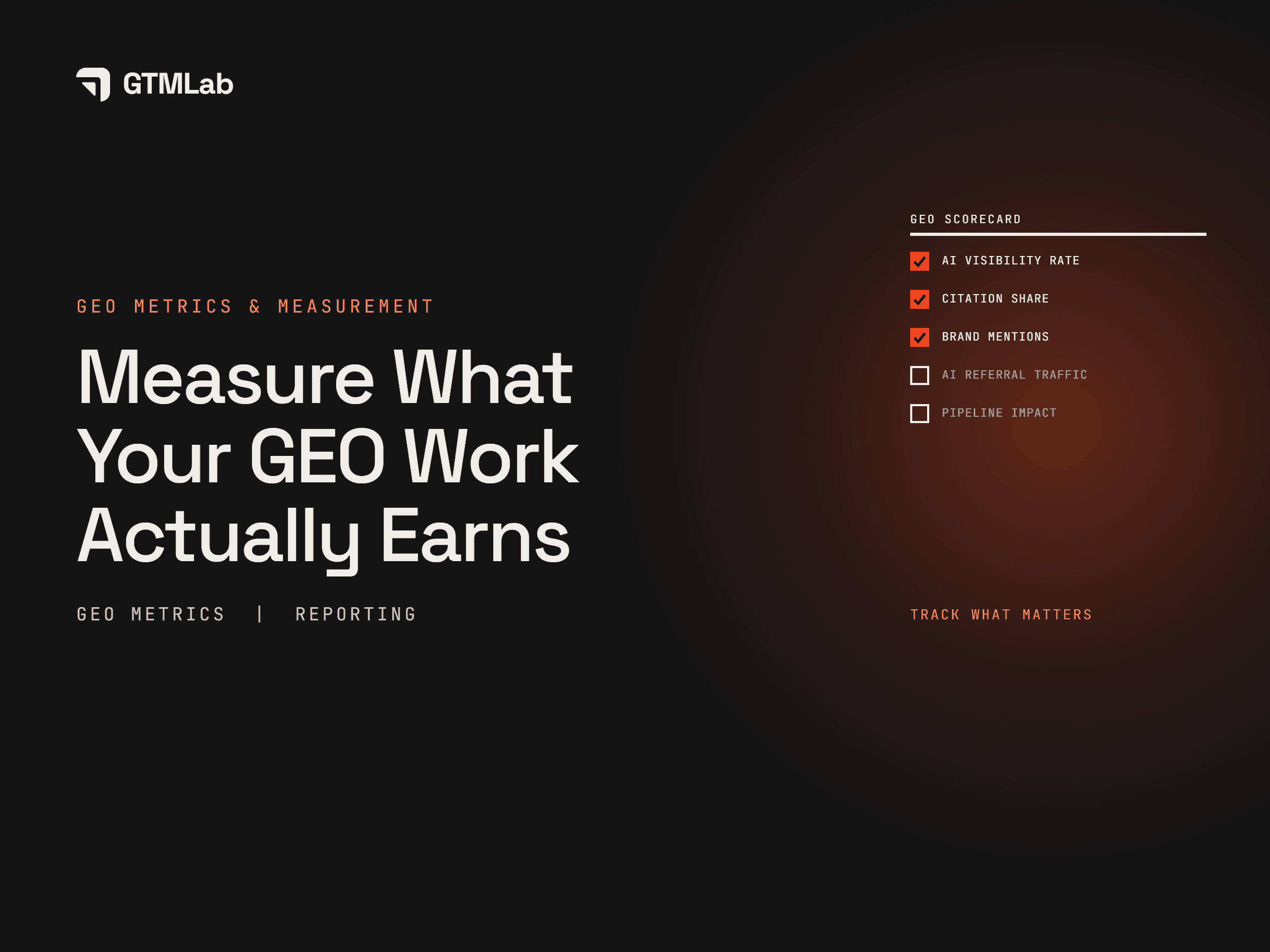
When measuring generative engine optimization (GEO), you can start with tracking how often AI answers mention, recommend, and cite your business. After that, you should review the website visits and enquiries you can identify from those platforms. Use a consistent set of buyer questions so you can compare results over time.
Each outcome tells you something different. Being named shows that your business appeared in an answer. A recommendation suggests it was presented as a suitable option. A citation identifies a supporting source, while an enquiry records a subsequent customer action. A useful measurement framework keeps those distinctions clear.
What Does GEO Success Look Like?
GEO success starts with appearing in answers that matter to your prospective customers. Your business could appear frequently for broad industry questions while remaining absent when people compare services, ask about a location or narrow their options.
Define what you want to improve for your priority services and markets. That might mean being recommended more consistently for a particular need, having accurate information repeated or seeing your own pages cited as supporting sources.
Read the answers alongside the numbers. An increase in mentions deserves closer inspection if the responses describe an outdated service or recommend your business for something you do not offer. Similarly, a recommendation supported by a third-party page should be recorded separately from a citation linking to your website.
Your report should show both how often you appear and whether the answer represents your business accurately.
Choosing the Prompts and Platforms You’ll Track
Start by choosing buyer questions that reflect real decisions. Cover the services, audiences and locations that matter to your business, then group the prompts so you can examine those areas separately.
Keep a stable core set for ongoing comparison. If you continually replace the questions, a change in your score could reflect the new selection rather than a change in how AI represents your business.
For each test, save the exact prompt, platform, search mode, date, target market, language, full answer and linked sources. Record relevant account or conversation settings too. Keeping these details consistent makes the results easier to interpret.
Account for differences between AI search platforms when organizing the data. Keep ChatGPT, the Gemini app and Perplexity results separate, and give Google AI Overviews and AI Mode their own records.
Choose a repeatable checking schedule that your team can maintain. Weekly checks with a monthly review can be a practical starting point. Repeat unexpected results before treating them as a trend, and retain previous answers so you can inspect what changed.
The Main GEO Metrics to Track
Once you’ve chosen the questions and platforms you want to track, focus on how your business appears in the answers. A few core metrics can help you understand your presence and identify areas that need attention
| Metric | What to look for |
|---|---|
| Brand mentions | How often your business is named in the answers you review. |
| Recommendations | Whether your business is suggested as an option that suits the customer’s needs. |
| Website citations | Website citations Whether an answer links to your website as a supporting source. |
| Share of voice | How often your brand is mentioned compared with competitors across the same set of questions. |
Read these measures together. Your business may be named without being recommended, while a recommendation may be supported by a third-party page rather than your own website. Recording these details separately helps you understand what each result means.
Pay attention to accuracy too. Check whether the answer describes your services correctly and whether the linked sources support those details. More frequent appearances are useful when they help people understand what you offer and who it suits.
Over time, look for consistent changes across the same core questions. Are you appearing for more relevant needs? Are the recommendations accurate? Are your pages being cited more often? Review these findings alongside website visits and enquiries to build a fuller picture of performance.
From AI Visibility to Website Visits and Enquiries
Once you understand how your business appears in AI answers, you can look at what happens when people reach your website. Where referral information is available, review which pages they visit and whether they take a relevant next step, such as sending an enquiry or requesting an appointment.
Focus on the outcomes that matter to your business. Keep visits, contact clicks and confirmed enquiries separate so you can see where interest turns into a conversation. If your records allow it, follow those enquiries through to bookings or customers.
The quality of those enquiries matters too. Consider whether they relate to the services you want to grow and come from the audiences you serve. This adds context to the number of visits or enquiries recorded.
Some people may discover your business through AI and contact you later through another channel. Use website analytics, enquiry records and customer feedback together, while making clear which connections are recorded and which are self-reported. Your GEO report can then show both changes in visibility and the customer activity you can identify.
What Your GEO Report Should Tell You
A useful GEO report should make it easy to understand what changed, which evidence supports the finding and what your team will do next.
| Report component | What to include |
|---|---|
| Measurement coverage | Prompt groups, platforms, markets, dates, captured-answer counts and collection gaps. |
| Visibility results | Mention, recommendation and citation rates, plus share of voice, broken down by platform and priority topic. |
| Business outcomes | Identifiable AI-referred sessions, confirmed enquiries and further sales outcomes where records support the connection. |
| Supporting evidence | Saved answers, cited URLs, factual errors and examples that explain material changes. |
| Next actions | The issue, relevant page or source, proposed change, responsible person and review date. |
Compare equivalent periods using the same core prompts and counting rules. When you add prompts or competitors, show the effect of that change separately. This helps readers understand whether the original set improved.
Describe percentage changes precisely. A mention rate rising from 20% to 30% is an increase of ten percentage points. Include the underlying counts and check whether the movement is concentrated in one platform, service or market.
Use the evidence to guide the next action. If answers repeat an incorrect service detail, identify the supporting source and verify what needs updating. If your pages receive citations but few identifiable visits, review the cited pages and customer journey before deciding what to change.
At GTMLab, the team turns these findings into content and website improvements focused on the questions your buyers ask. The AI search optimization work combines implementation with ongoing monitoring, so you can see what was changed and how your business appears in later checks.
Frequently Asked Questions
Can you measure GEO without a paid tracking tool?
Yes. A spreadsheet and saved responses can support an initial review of a manageable prompt set. Record the testing conditions, answers and source links consistently. A tracking platform becomes more useful as the number of prompts, markets and repeated checks grows, but you still need to inspect the underlying answers.
How many prompts should you track?
Choose enough to cover your priority services, customer needs and markets without making the review unmanageable. Begin with a set you can check consistently, then expand where an important topic is missing. Document the coverage rather than treating a particular prompt count as proof that the sample represents all customer demand.
Should branded and non-branded prompts be measured together?
Keep them in separate groups. Branded prompts help you assess what AI says when someone already knows your business. Non-branded prompts help you examine whether it appears when someone asks about a category or need. Combining them into one rate makes those different situations harder to assess.
How should you handle abbreviations or similar business names?
Maintain a list of verified brand names, abbreviations and spelling variants. Review ambiguous matches manually, especially when your name is also a common word or resembles another company. Apply the same matching rules to earlier and later periods so changes in classification do not distort the trend.


