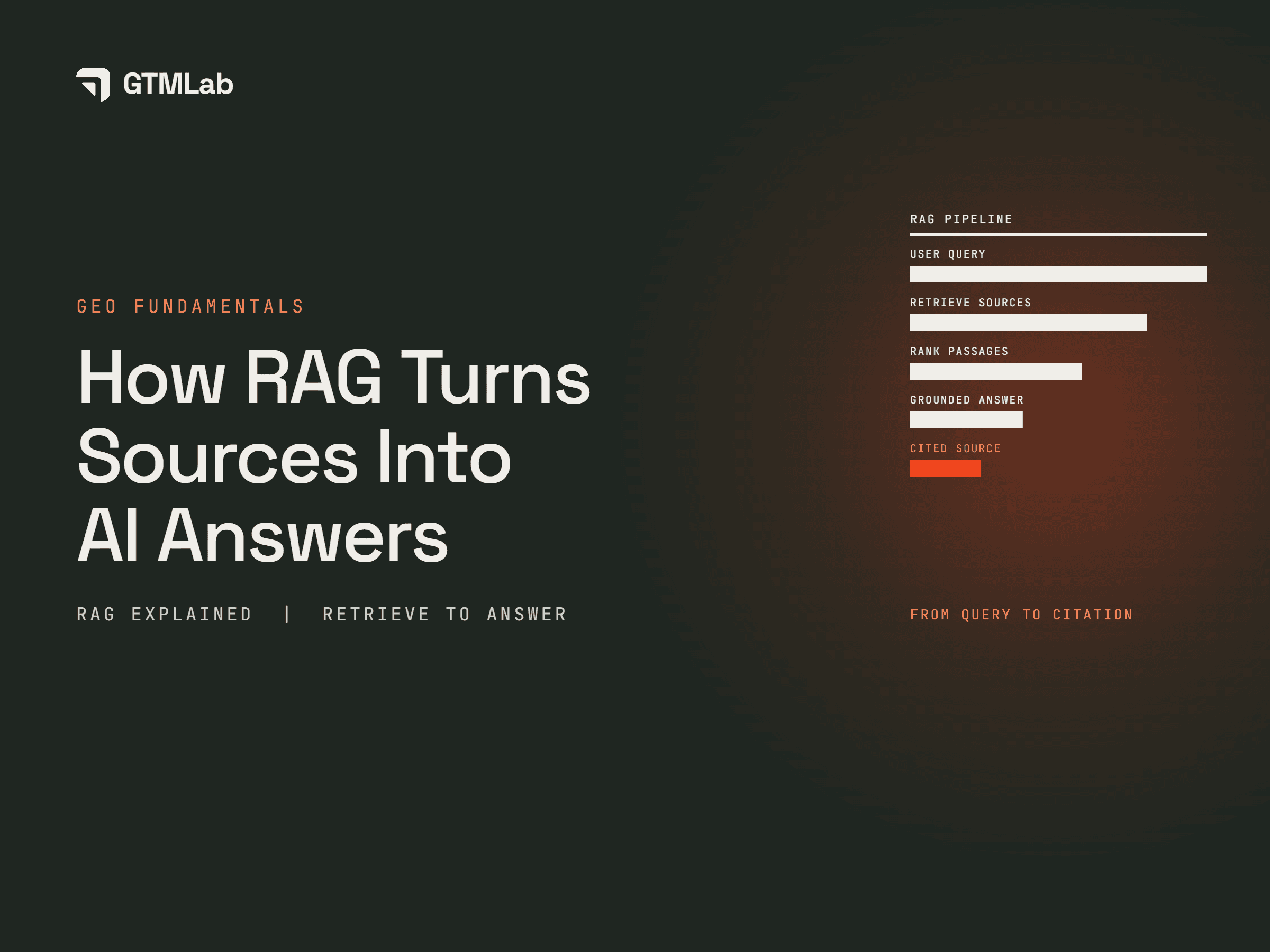
Retrieval-augmented generation (RAG) works by finding relevant information outside a language model and providing it as context for an answer. In AI search, that information can come from web pages or a search index. The model then uses the retrieved material to help respond to your question.
For your business, this creates a reason to look closely at what your website actually explains. A page might contain the facts needed to answer a customer’s question, but those facts still need to be found, selected and represented accurately. Understanding RAG helps you see where that process can succeed or break down.
What RAG Adds to an AI Answer
A language model learns patterns and information during training. RAG adds an external source of information when the system responds, so the answer can draw on material beyond what the model learned earlier. The original RAG research combined a trained language model with a retriever that accessed passages from an external collection.
This distinction matters when your business changes its services, prices or policies. A system using retrieval can consult updated information without retraining the underlying model for every change. However, the source it accesses must actually contain the update.
RAG also extends beyond public websites. An internal assistant might retrieve information from company documents or a product database. A web search experience uses a different collection of sources and access rules. Google Cloud’s explanation of RAG describes this broader combination of retrieval systems and language generation.
RAG describes an approach. Individual AI search platforms can implement it differently, and a response generated without external retrieval follows a different path.
How Retrieval and Generation Work Together
The basic process has three parts: retrieve information, add it to the model’s context and generate an answer. Google’s RAG walkthrough explains these as retrieve, augment and generate.
Retrieve relevant information
The system searches an external collection for material relevant to the question. Retrieval can use keyword matching, semantic search that looks for related meaning, or a combination of methods.
For example, a question about software that “keeps customer conversations in one place” could be relevant to documentation about a shared inbox, even when the wording differs.
Some RAG systems prepare documents by dividing them into smaller passages and creating numerical representations called embedding. These help retrieve text with related meaning. This is one implementation approach, rather than a requirement that every AI search engine follows identically.
Add the information to the model’s context
Selected passages are supplied alongside the question and instructions. This is the augmentation step: the model receives reference material to use while composing its response.
The selection matters. If the context leaves out an important exception, the answer may miss it too.
Generate the answer
The model uses the supplied context to compose a response. A search product may also display links to supporting sources.
Retrieval and citation are separate events. Finding a page does not automatically mean the final answer will cite it or recommend the business that published it. That distinction also matters when working to earn citations in Perplexity, where a source link and a brand recommendation show different outcomes.
A RAG Example From a Hotel Search
Imagine a traveller asks:
Which hotels in central Jakarta have a family room with a separate bedroom for children?
In a simplified retrieval-based workflow, the system would look for information about hotels, locations and specific room layouts. Relevant material might include official room descriptions and travel listings.
Suppose a hypothetical hotel’s room page states that its family suite has two separate bedrooms, while another hotel only lists a sofa bed in the main sleeping area. Those details would help distinguish which property matches the request.
The model could then explain the room options using the retrieved information. If the platform provides citations, the traveller could open the supporting pages to check the details.
For your hotel, a practical content priority would be to describe the room configuration precisely. “Perfect for families” leaves the sleeping arrangement unclear. Naming the room, its layout and occupancy rules gives readers concrete information to assess.
This example illustrates the process; it does not represent a recorded AI result.
Preparing Your Website for Retrieval
You cannot control which sources an AI search platform selects. You can review whether your website gives it useful, accessible information about the questions your customers ask.
Put the answer beside the relevant heading
If a customer asks whether your software integrates with a particular CRM, name the supported integration and explain its requirements. If your service has geographic limits, state the locations clearly.
Keep essential qualifications close to the main claim. A price should include what it covers, while a feature description should identify which plan or product offers it.
When preparing content for answer engines, give each section a clear purpose, answer a specific question and provide supporting evidence.
Make the information accessible and connected
Review whether important pages can be discovered and whether their content is available to the relevant search systems. Link related pages where the connection helps a reader continue their research.
For Google specifically, the guidance says that supporting pages in AI Overviews and AI Mode must be indexed and eligible to appear in Search with a snippet. It also recommends intel links and making important information available as text. Those are Google’s requirements for this AI Overviews, rather than a universal checklist for every RAG system.
Maintain facts customers rely on
Review service descriptions, availability, specifications, and policies when they change. Where several pages describe the same offer, check that they agree.
For example, if a transfer is included only in one tour package, make that boundary explicit wherever the inclusion is mentioned. This gives readers a clearer basis for comparing offers and reduces contradictory information across your website.
Where RAG Can Still Give the Wrong Answer
External information can improve an answer, but the process can fail at several points. The system might retrieve irrelevant material, encounter an outdated source or generate a statement that the supplied information does not support. Google’s RAG evaluation guide separates retrieval quality, use of context and generation quality for this reason.
In the hotel example, an old listing might describe a room layout that has changed. Alternatively, a response might find the correct room page but generalise one suite’s features to the whole property. Each issue calls for a different check.
When reviewing your business in AI search, save the question, response and cited URLs. Open the sources and compare their actual wording with the answer. Check whether a claim applies to the right product, service, location or date.
You can then turn an observed gap into a specific task: clarify a room description, correct a third-party listing or update a service page. Repeat the question over time to see whether the representation changes.
When tracking AI visibility, record mentions, citations, and recommendations separately. Understanding RAG gives you a way to investigate the information behind an answer and decide what your team can improve.
Frequently Asked Questions
Is RAG the same as fine-tuning?
No. RAG supplies external information when a model generates an answer. Fine-tuning adapts the model through additional training. They can also work together, with a fine-tuned model using retrieved information to respond.
Does my business need its own RAG system to appear in AI search?
No. Building a RAG system is relevant when creating your own AI application. For visibility in Google’s AI search features, your website needs to meet its existing Search requirements. Focus on accessible pages, useful content and accurate business information.
Can RAG use information from PDF documents?
Yes, when the retrieval system supports PDFs and can extract their contents. Scanned documents may require optical character recognition (OCR) to make the text readable. For your website, keep essential service details available on relevant web pages alongside downloadable brochures.
How is RAG different from query fan-out?
RAG retrieves external information to support a generated answer. Query fan-out expands a user’s question into several related searches to gather additional information. The two can work together, with query fan-out helping a search system collect material for its response.


